The Hidden Risk of Holiday Shopping
The excitement around Black Friday is palpable. For millions of shoppers, it’s a highly anticipated event, a race to snag the best deals on everything from the latest tech to holiday gifts. The thrill of the hunt and the satisfaction of a deep discount are a powerful combination. But this annual retail frenzy is also a peak season for cybercriminals, who have already laid thousands of digital traps for unsuspecting shoppers.
As shoppers gear up for one of the biggest retail events of the year, this excitement can lead to rushed decisions and lowered guards. It’s this exact environment that cybercriminals are poised to exploit. Recognizing this heightened danger, online retail giant Amazon has issued an urgent warning to its more than 300 million active users, alerting them to the escalating risk of impersonation scams and cybercrime designed to turn a great deal into a costly mistake.
Here are the four key takeaways from the warning and what you can do to protect yourself.
You can hear it as an audio
1. The Sheer Scale of Fake Shopping Sites is Staggering
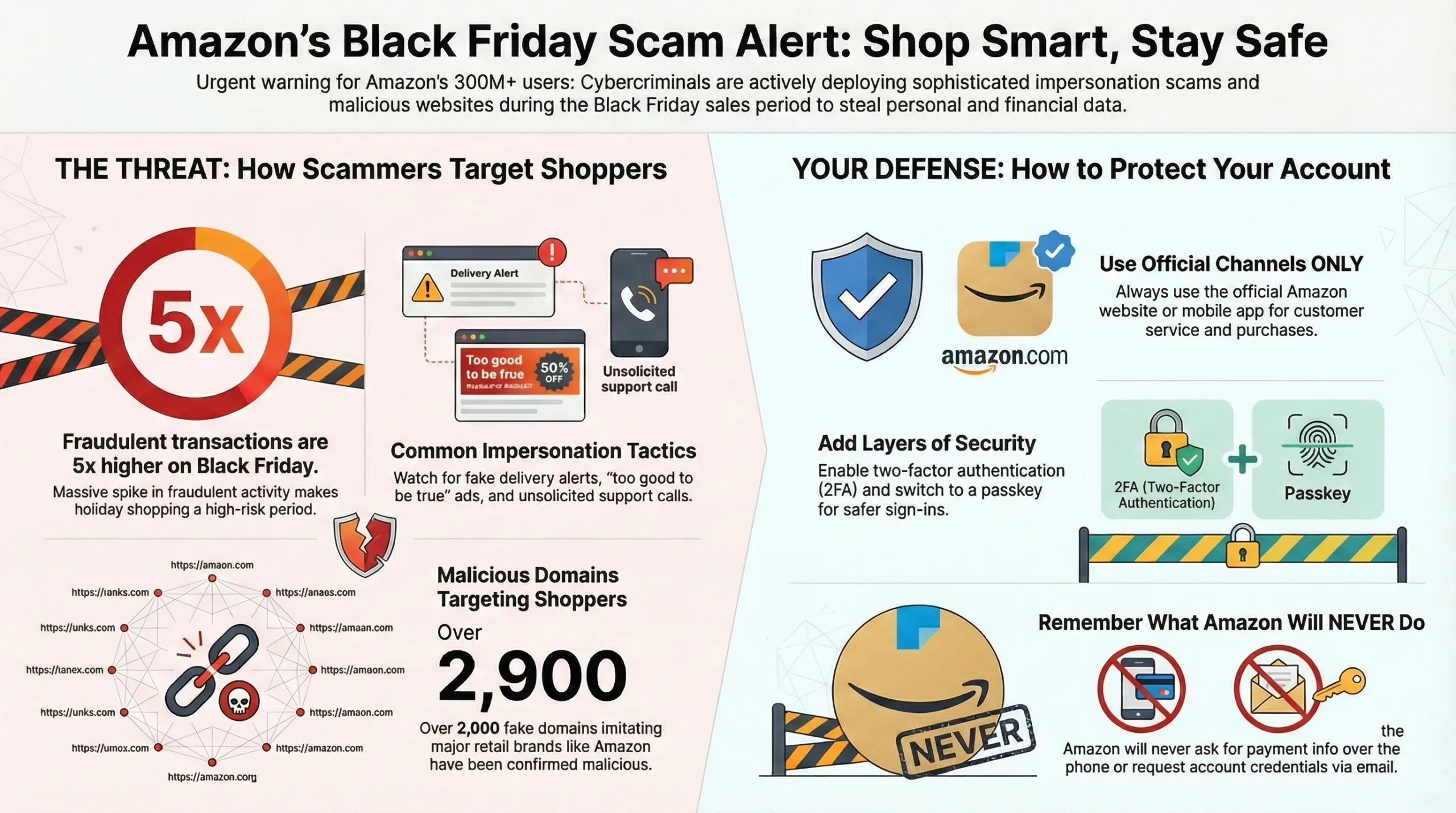
Recent findings from a FortiGuard Labs report paint a startling picture of the pre-holiday threat landscape. In the last three months alone, researchers identified the registration of over 18,000 new holiday-themed domains using terms like “Black Friday” or “Flash Sale,” with at least 750 confirmed to be malicious. Even more alarmingly, over 19,000 domains were registered specifically to imitate major retail brands like Amazon, and of those, 2,900 were confirmed as malicious.
The danger lies in their subtle deception. Scammers register domains with slight, easily missed variations, banking on the fact that deal-focused shoppers are moving too quickly to notice the difference between a legitimate retailer and a data-harvesting clone. This makes the threat of landing on a fake site widespread, turning a quick click into a potential security breach.
2. Scams Aren’t Just in Your Inbox Anymore
While many consumers have become adept at spotting suspicious emails, scammers have diversified their tactics. They are now reaching potential victims across a wide range of platforms, knowing that a multi-channel approach increases their chances of success. It’s crucial to be aware of these other common attack methods:
- Fake messages about supposed issues with your account or a pending delivery.
- Third-party adverts on social media platforms promoting deals that seem too good to be true.
- Unsolicited phone calls from individuals claiming to be from tech support.
To understand the foundational threat, Amazon provides a clear definition of the tactic scammers use:
“Impersonation scams occur when a scammer pretends to be a trustworthy organization or person in order to steal your money or personal information. Impersonation scams are perpetrated in a wide variety of ways—by phone, email, text, or even by messaging you on social media.”
This evolution means that vigilance can no longer be confined to your email inbox. It must extend to every text, social media message, and phone call you receive.
3. AI Is Now Powering a New Wave of Scams
The scams targeting shoppers are not just more numerous; they are also becoming more sophisticated, thanks to the rise of artificial intelligence. Cybercriminals are leveraging AI to create fraudulent communications and websites that are more polished and convincing than ever before.
According to Anne Cutler from the cybersecurity firm Keeper Security, AI is being used to create convincingly forged order confirmations, spoofed retailer sites, and even AI-generated customer service messages designed to trick you into handing over your login information. This is a game-changer because AI removes many of the classic red flags, like poor grammar or unprofessional design, making fraudulent messages and sites much harder for the average person to spot. This use of AI not only makes individual scams more convincing but also enables criminals to generate the thousands of malicious domains mentioned earlier at an unprecedented scale and speed.
4. The Financial Risk Is Real and Growing
The financial cost of these scams is not theoretical—it’s staggering and growing. A 2024 report from the FBI’s Internet Crime Complaint Center found that victims reported over $16 billion in losses from cybercrime, a staggering 33% increase from the previous year.
The risk escalates dramatically during major shopping events. A report from Seon, a fraud prevention company, found that fraudulent transactions were approximately five times higher on Black Friday and four times higher on Cyber Monday when compared to a baseline period in October. These statistics confirm that the shopping season is a prime time for financial fraud, transforming the abstract threat of a scam into a documented, multi-billion-dollar reality for consumers.
Fraudulent transaction rates, indexed to October as the baseline. Source: Seon, cited above.
What Amazon Recommends You Do
To fight back against these evolving threats, it’s crucial to adopt the security practices Amazon officially recommends. Following these key security practices can significantly reduce your risk of falling victim to a scam.
- Stick to Official Channels: Always use the official Amazon mobile app or the Amazon.com website for all services. This includes making purchases, contacting customer service, changing account details, and tracking deliveries.
- Enable Two-Factor Authentication: Activate two-factor authentication (2FA) on your account whenever possible. This adds a critical layer of security that can block unauthorized access even if your password is stolen.
- Consider a Passkey: For an even more secure sign-in method, switch to a passkey. This modern approach uses the same biometric data (your face, fingerprint, or PIN) that you use to unlock your device, making it much harder for scammers to compromise.
Finally, remember this crucial fact: Amazon will never ask you to make payments or provide payment information over the phone, nor will it ever send emails asking you to verify your account credentials.
Beyond Amazon: The Other Scams Flooding Your Phone This Season
Amazon’s warning focuses on impersonation of its own brand specifically, but the same weeks bring a wider spread of tactics that have nothing to do with Amazon at all, and knowing the shape of each one is faster than trying to spot every fake site individually.
Fake delivery texts (“smishing”). A text claiming to be from USPS, FedEx, UPS, or a courier, warning that a package couldn’t be delivered or a small fee is owed, with a link to “reschedule.” Real carriers don’t ask for a card number by text to release a package.
Brushing scams. A package you never ordered arrives, often with no return address, sent by a third-party seller to inflate their own review count under your name. If this happens, don’t scan any QR code or click any link included in or on the box, and check whether your account has been compromised as the source of your address.
QR code scams (“quishing”). Fake QR codes on flyers, parking signs, or seasonal promotional posters that route to a phishing page instead of the advertised deal. A QR code hides its destination until you’ve already scanned it, which is exactly why it’s a popular scam vector during a season full of legitimate promotional QR codes.
Fake giveaways and charity posts. Social media accounts impersonating real brands, running “like and share to win” giveaways that collect personal information, or fake charity drives timed to holiday generosity.
If You Think You’ve Already Been Scammed
Speed matters more than anything else here, most damage from a shopping scam happens in the hours right after it, not weeks later.
Contact your bank or card issuer immediately to dispute the charge and freeze or replace the card, most issuers have a 24/7 fraud line specifically for this. Change the password on the affected account, and on any other account reusing that same password, then enable two-factor authentication if it wasn’t already on. Report it both to the retailer or platform being impersonated and to the FTC at reportfraud.ftc.gov, which feeds real cases into the same law enforcement data cited earlier in this piece. Finally, watch your statements and credit report closely for the following few weeks, some fraud shows up as a small test charge before a larger one follows.
Conclusion: Shop Smart, Stay Safe
The allure of Black Friday and Cyber Monday deals is undeniable, but it’s essential to approach the season with a healthy dose of caution. The threats are real, financially significant, and constantly evolving with new technology. By staying informed and adopting simple but effective security habits, you can protect your personal and financial information without missing out on the savings.
As you hunt for deals this year, will you be enabling two-factor authentication or switching to a passkey to lock down your accounts?