By ANUPRESS Team · Last reviewed August 2026 · 14 min read
Most people meet Roman numerals twice: once in school, and once years later when they need a wedding date on a ring and cannot remember whether 4 is IV or IIII. The system runs on seven letters and two rules, and once those click, you can read any of them without looking anything up. This page has the rules, a full chart from 1 to 100, the years you are most likely to need, and the handful of mistakes that trip up almost everyone.
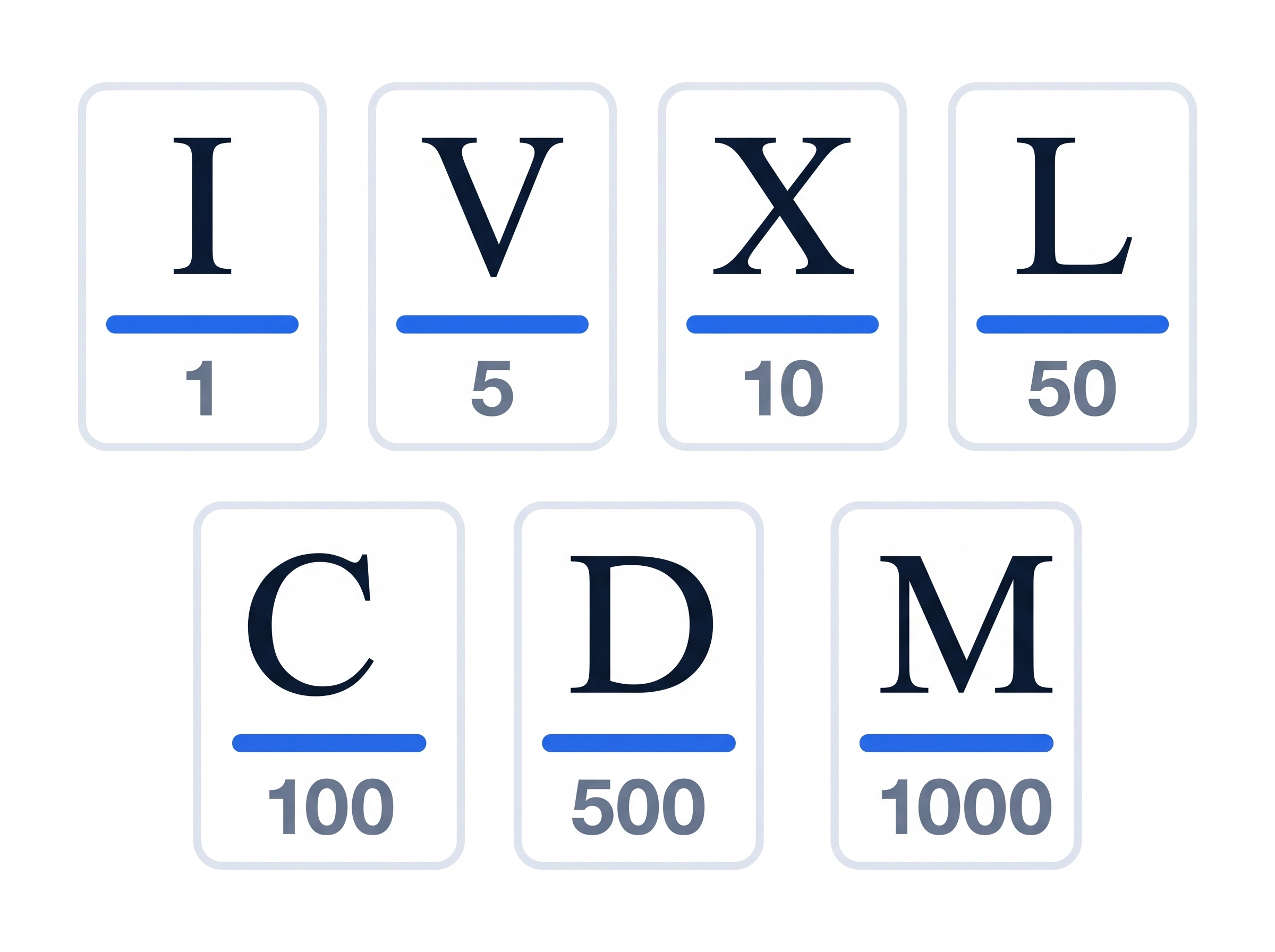
The whole system is built from seven letters of the Latin alphabet. There is no eighth symbol waiting to ambush you, no special case for large numbers within the normal range, and no zero. Every Roman numeral you will ever see, on a clock, a cornerstone, a film credit, or a Super Bowl logo, is some arrangement of those seven letters.
What makes them feel harder than they are is that the rules were never written down by the Romans. They settled into their current shape over centuries, which is why you will find a Victorian building marked MDCCCLXXXVIII and a medieval clock face marked IIII, both correct for their moment and neither matching what a modern textbook would accept. This page teaches the modern standard, then explains the exceptions you will actually run into.
On this page
- The seven letters
- The two rules that do all the work
- The six subtractive pairs
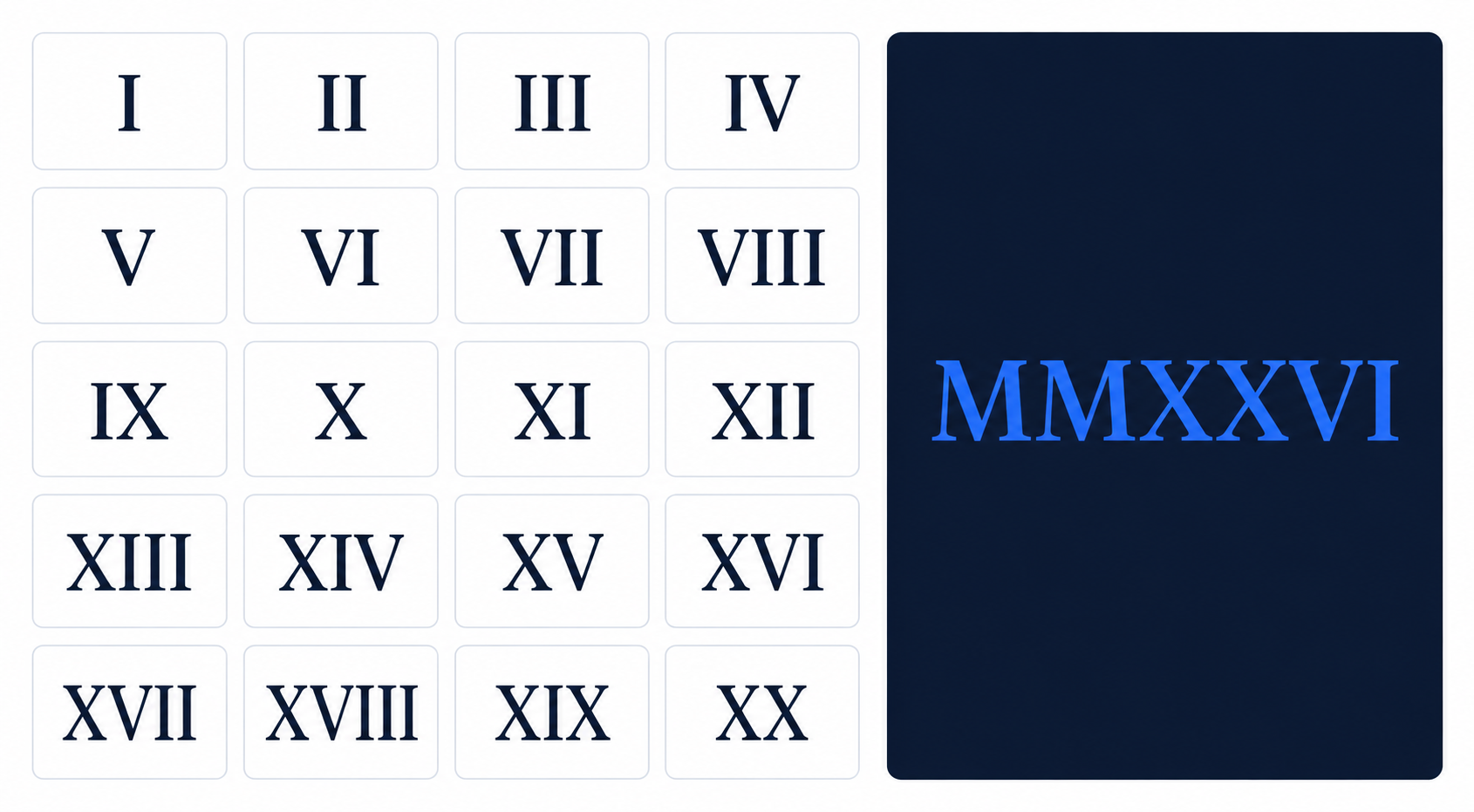
- Roman numerals 1 to 100
- Tens, hundreds and thousands
- Converting a number, step by step
- Reading a numeral back
- Roman numerals for years
- Dates for tattoos and rings
- Seven mistakes people actually make
- Why clocks use IIII
- Where you still see them
- Past 3,999: the overline
- Why there is no zero
- Frequently asked questions
- Quick reference
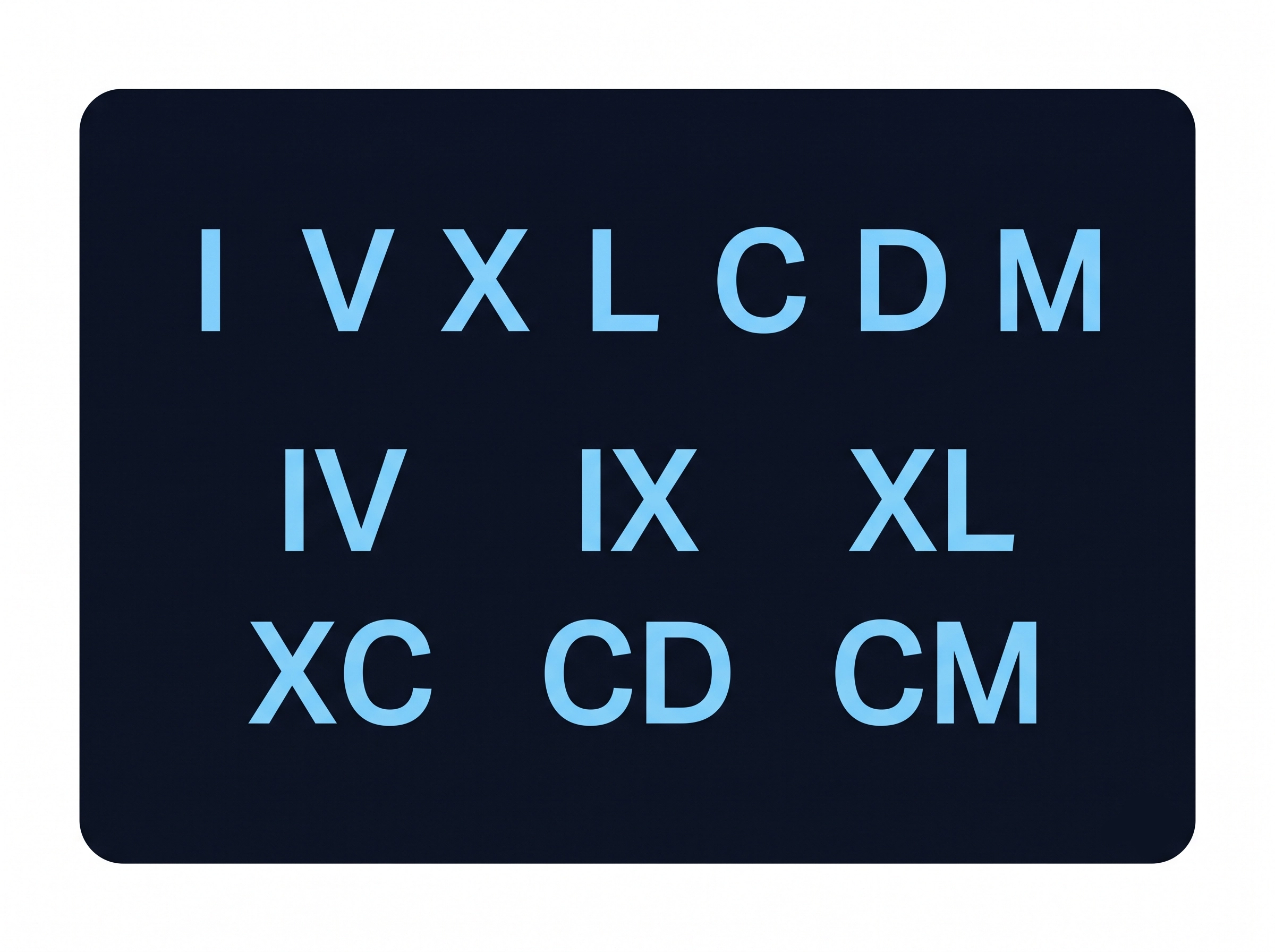
The seven letters
Each letter has one fixed value that never changes based on where it sits. That last part matters more than it sounds. In our normal numbers, the 2 in 2,000 means something completely different from the 2 in 20. In Roman numerals, an X is always ten, whether it is the first letter or the last.
| Letter | Value | Repeatable? | Can it subtract? |
|---|---|---|---|
| I | 1 | Yes, up to 3 | Yes, before V and X |
| V | 5 | No | No |
| X | 10 | Yes, up to 3 | Yes, before L and C |
| L | 50 | No | No |
| C | 100 | Yes, up to 3 | Yes, before D and M |
| D | 500 | No | No |
| M | 1,000 | Yes, up to 3 | No, nothing is bigger |
A pattern worth noticing: the letters alternate between 1s and 5s. I, X, C and M are the “one” of each place value, and V, L and D are the “five”. The 1s repeat and subtract. The 5s do neither.
The two rules that do all the work
Read any Roman numeral from left to right and compare each letter to the one after it. That comparison tells you whether to add or subtract, and that is genuinely the whole system.
When a letter is followed by one of equal or smaller value, you add. VI is 5 then 1, so 6. XXX is three tens, so 30. LXVI is 50, 10, 5, 1, which comes to 66. Because the letters run in descending order, most numerals are just a running total.
When a letter is followed by a larger one, you subtract it instead. IV is 1 before 5, so 4. XC is 10 before 100, so 90. The smaller letter is a signal to take it off the bigger one rather than add it on.
That is why IV and VI look so similar but mean different things. Same two letters, and the order carries all the meaning. If you can hold on to that, you can decode almost anything without a chart.
The rules in one line each
- Letters run from largest to smallest, and you add as you go
- A smaller letter placed before a larger one gets subtracted instead
- I, X, C and M can appear up to three times in a row
- V, L and D never repeat, and never subtract
- Only six subtractive pairs exist, and they are listed below
The six subtractive pairs
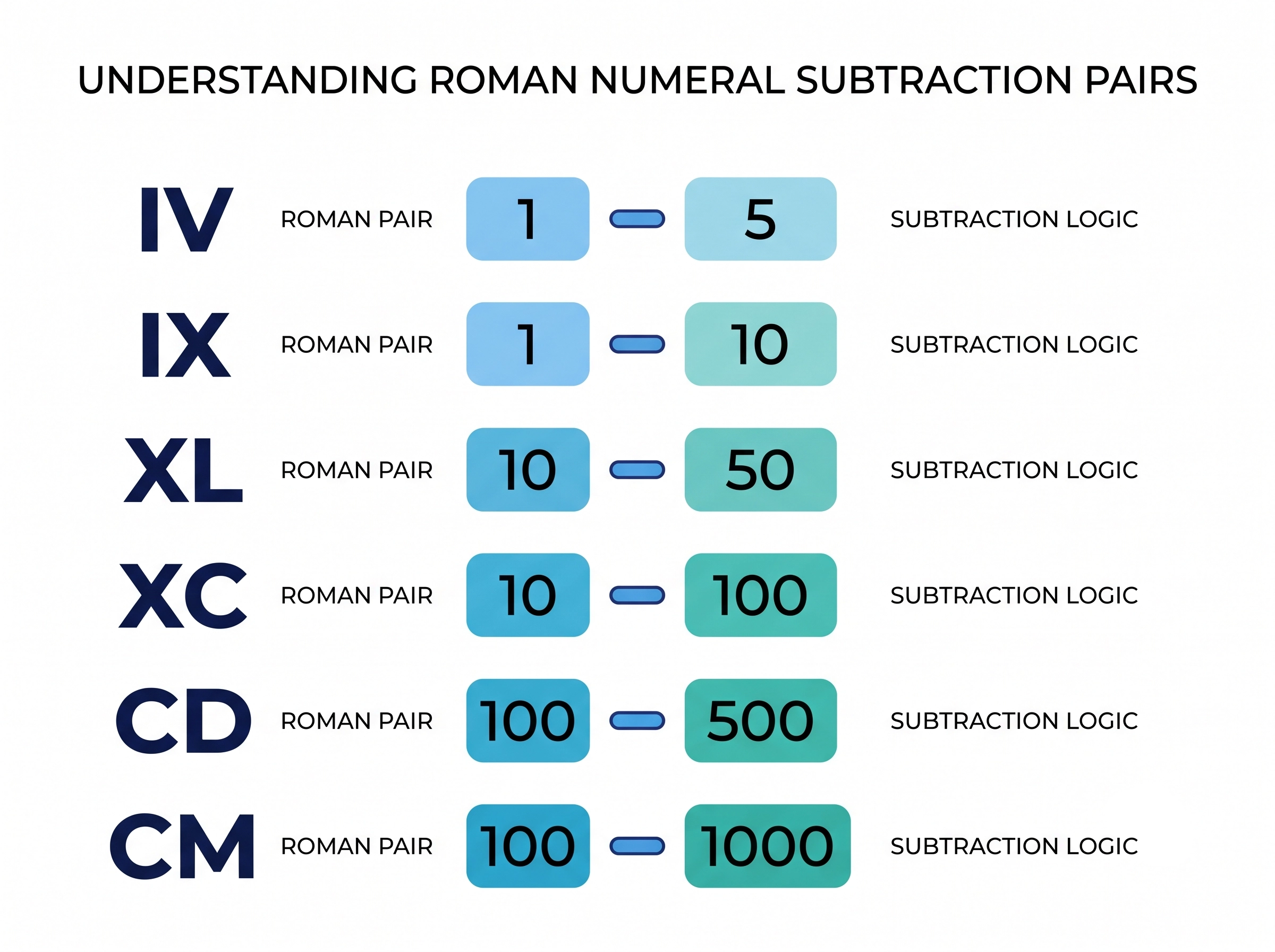
Subtraction sounds like it should be flexible. It is not. Only six combinations are valid, and every other attempt at subtracting is wrong no matter how sensible it looks.
| Pair | Value | How it reads |
|---|---|---|
| IV | 4 | 5 minus 1 |
| IX | 9 | 10 minus 1 |
| XL | 40 | 50 minus 10 |
| XC | 90 | 100 minus 10 |
| CD | 400 | 500 minus 100 |
| CM | 900 | 1,000 minus 100 |
Two restrictions produce that list. Only I, X and C can be subtracted, which rules out anything starting with V, L or D. And each of them can only be taken from the next two letters up the scale, so I works against V and X but not against L or anything larger.
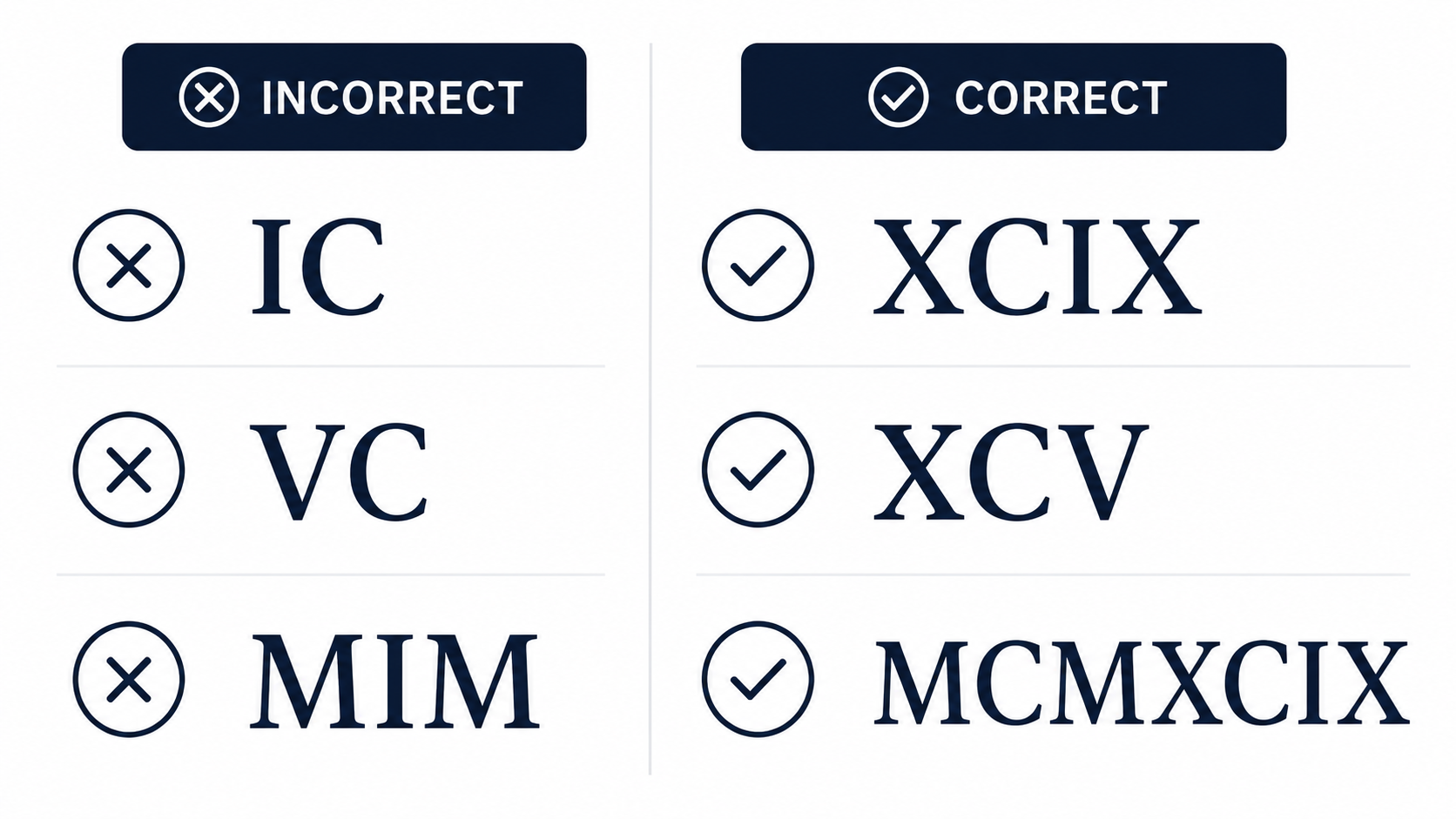
This is why 99 is XCIX and not IC, even though IC looks tidier and the arithmetic works out. You subtract in place-value chunks: ninety (XC) followed by nine (IX). The same logic makes 1999 MCMXCIX rather than the much shorter MIM that people occasionally propose. Shorter is not the goal. Consistent place values are.
Roman numerals 1 to 100
Here is the full run. It is worth scanning even if you only need one number from it, because the repeating shape of each block of ten is the fastest way to stop needing a chart at all.
Look at any row of ten and you will see the same skeleton: three of the small letter, a subtractive pair, the five, three more, another subtractive pair, then the next ten. XXI through XXX behaves exactly like I through X with an XX bolted on the front. Once you have 1 to 10, you effectively have 1 to 100.
Skip the mental arithmetic
Our free Roman numeral converter runs both directions: type a number from 1 to 3,999 to get the numeral, or paste a numeral to get the number. It validates strictly, so invalid forms like IIII or VX are rejected rather than quietly guessed at. Nothing you type leaves your browser.
Open the Roman numeral converterFree, no sign-up, and it shows the working rather than just the answer.
Tens, hundreds and thousands
Above 100, the same shape repeats one place value up. If you know that 40 is XL, then 400 is CD for exactly the same reason, one letter shifted along the scale.
| Tens | Hundreds | Thousands |
|---|---|---|
| 10 = X | 100 = C | 1,000 = M |
| 20 = XX | 200 = CC | 2,000 = MM |
| 30 = XXX | 300 = CCC | 3,000 = MMM |
| 40 = XL | 400 = CD | 4,000 needs an overline |
| 50 = L | 500 = D | See the overline section |
| 60 = LX | 600 = DC | |
| 70 = LXX | 700 = DCC | |
| 80 = LXXX | 800 = DCCC | |
| 90 = XC | 900 = CM |
MMM is where standard Roman numerals stop climbing, because a fourth M would break the three-in-a-row limit. That caps the system at 3,999, or MMMCMXCIX.
Converting a number, step by step
Break the number apart by place value, convert each piece on its own, then push them back together in order. Take 1,847.
1,847 in four moves
- Split it: 1,000 + 800 + 40 + 7
- 1,000 is M. 800 is DCCC. 40 is XL. 7 is VII.
- Join them largest first: M + DCCC + XL + VII
- 1,847 = MDCCCXLVII
The order never changes. Thousands, then hundreds, then tens, then units, each converted independently. You never have to think about how the 800 interacts with the 40, because it does not.
One nice quirk falls out of this. The year 1666 is MDCLXVI, which uses all seven letters exactly once, in descending order. It has not happened before and will not happen again inside the standard range.
Reading a numeral back
Going the other way, walk left to right and check each letter against its neighbour. Take MCMXCIV, which shows up on a lot of film credits.
M is 1,000, and nothing before it, so start at 1,000. C is followed by M, a bigger letter, so CM is a subtractive pair worth 900. Running total: 1,900. X is followed by C, so XC is 90. Total: 1,990. I is followed by V, so IV is 4. MCMXCIV is 1994.
The trick that makes this fast is scanning for subtractive pairs first, before you add anything. Spot the CM, XC and IV as single chunks, and you are adding four numbers rather than tracking seven letters.
Roman numerals for years
Years are the most common real-world use, mostly on buildings, book copyright pages, and film credits. Here are the ones people look up most, plus a few landmarks.
| Year | Roman numeral |
|---|---|
| 1066 | MLXVI |
| 1492 | MCDXCII |
| 1776 | MDCCLXXVI |
| 1789 | MDCCLXXXIX |
| 1888 | MDCCCLXXXVIII |
| 1900 | MCM |
| 1969 | MCMLXIX |
| 1984 | MCMLXXXIV |
| 1999 | MCMXCIX |
| 2000 | MM |
| 2001 | MMI |
| 2020 | MMXX |
| 2024 | MMXXIV |
| 2025 | MMXXV |
| 2026 | MMXXVI |
| 2027 | MMXXVII |
| 2030 | MMXXX |
| 2050 | MML |
| 2100 | MMC |
The 1900s are long because 900 is CM and 1,000 is M, so almost every twentieth-century year starts with the awkward MCM. That is why a 1988 cornerstone reads MCMLXXXVIII and takes a moment to parse, while 2026 is a tidy MMXXVI. We are in an easy century for this.
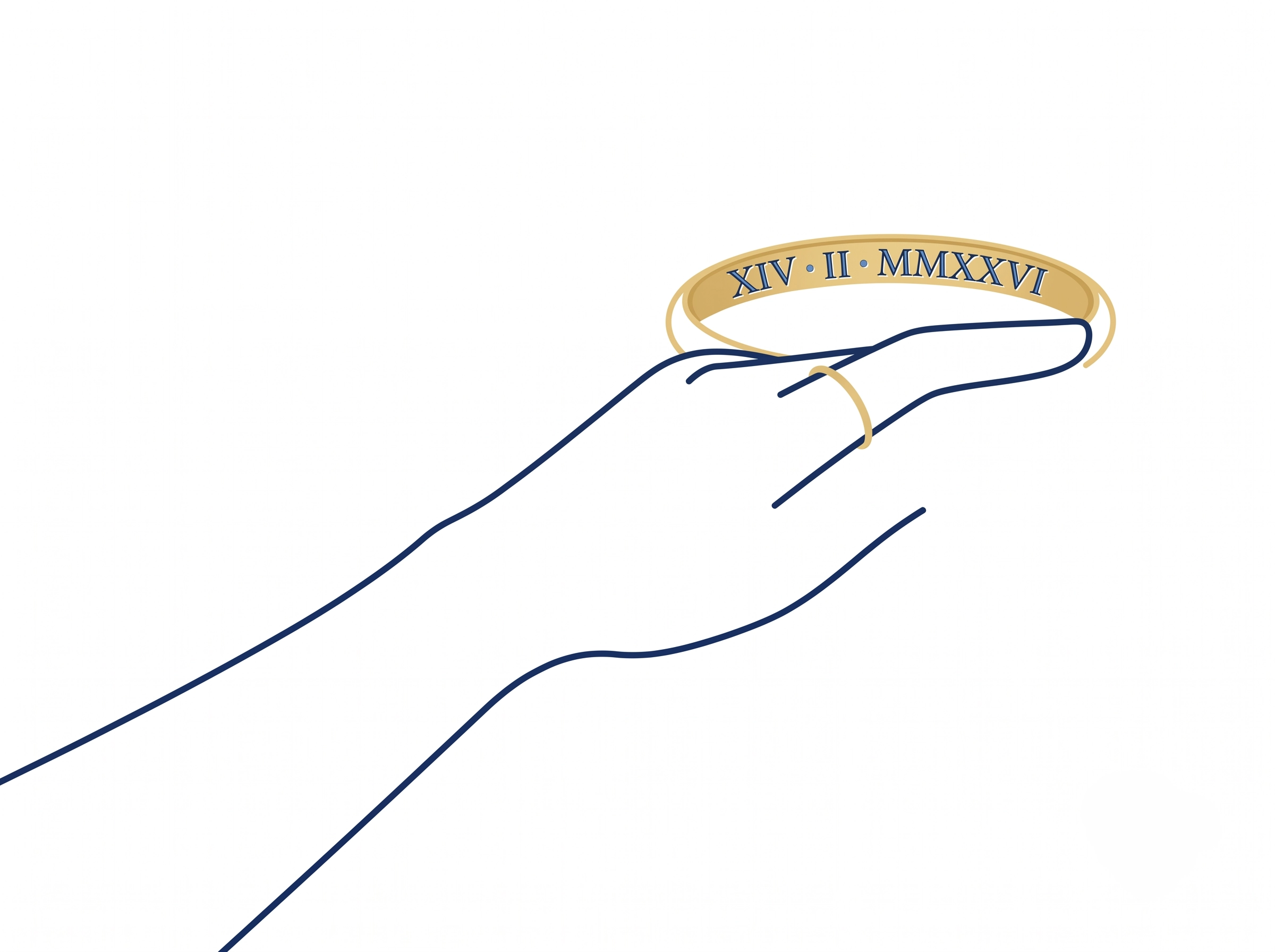
Dates for tattoos, rings and invitations
This is what most people are actually here for, so it is worth being careful. There is no official Roman numeral date format, which means the convention is whatever is legible and consistent. Two things do matter: pick a field order and separate the parts clearly.
Convert each part of the date separately. The day, the month number, and the year each become their own numeral, and they are never merged into one long string. A separator keeps them readable.
Day-month-year is the usual choice in Europe, month-day-year in the US. Neither is more correct, but the ambiguity is real: XIV · II could be the 14th of February or, read the other way, nonsense, because there is no 14th month. That accidental safety net disappears for any date where both numbers are 12 or under. III · IV is either 3 April or 4 March depending entirely on which convention you had in mind, and a tattoo artist cannot tell the difference.
If the date is going on skin or metal, write out what it means somewhere before you commit. Get the numeral, get the plain-English date, and check them against each other. Our Roman numeral converter handles each part, and the date calculator is useful if you also want the weekday or the exact number of days since.
Seven mistakes people actually make
Almost every error comes from applying subtraction too freely. These are the ones that turn up again and again.
| Wrong | Right | Why |
|---|---|---|
| IIII | IV | Four in a row breaks the three-repeat limit (clock faces excepted) |
| IC | XCIX | I can only be subtracted from V or X |
| VC | XCV | V never subtracts from anything |
| MIM | MCMXCIX | 1999 subtracts by place value, not all at once |
| VV | X | V, L and D never repeat |
| XD | CDXC | X only subtracts from L or C |
| MMMM | See overline section | 4,000 is outside the standard range |
The pattern behind all of them: subtraction is not general-purpose arithmetic. It is six fixed pairs, and anything outside those six is a spelling error rather than a shortcut.
Old inscriptions are a separate matter. You will find genuine Victorian buildings marked MDCCCC for 1900 instead of MCM, and medieval manuscripts using IIII freely. Those are not mistakes in their own context. They just predate the standard we use now.
Why clock faces use IIII
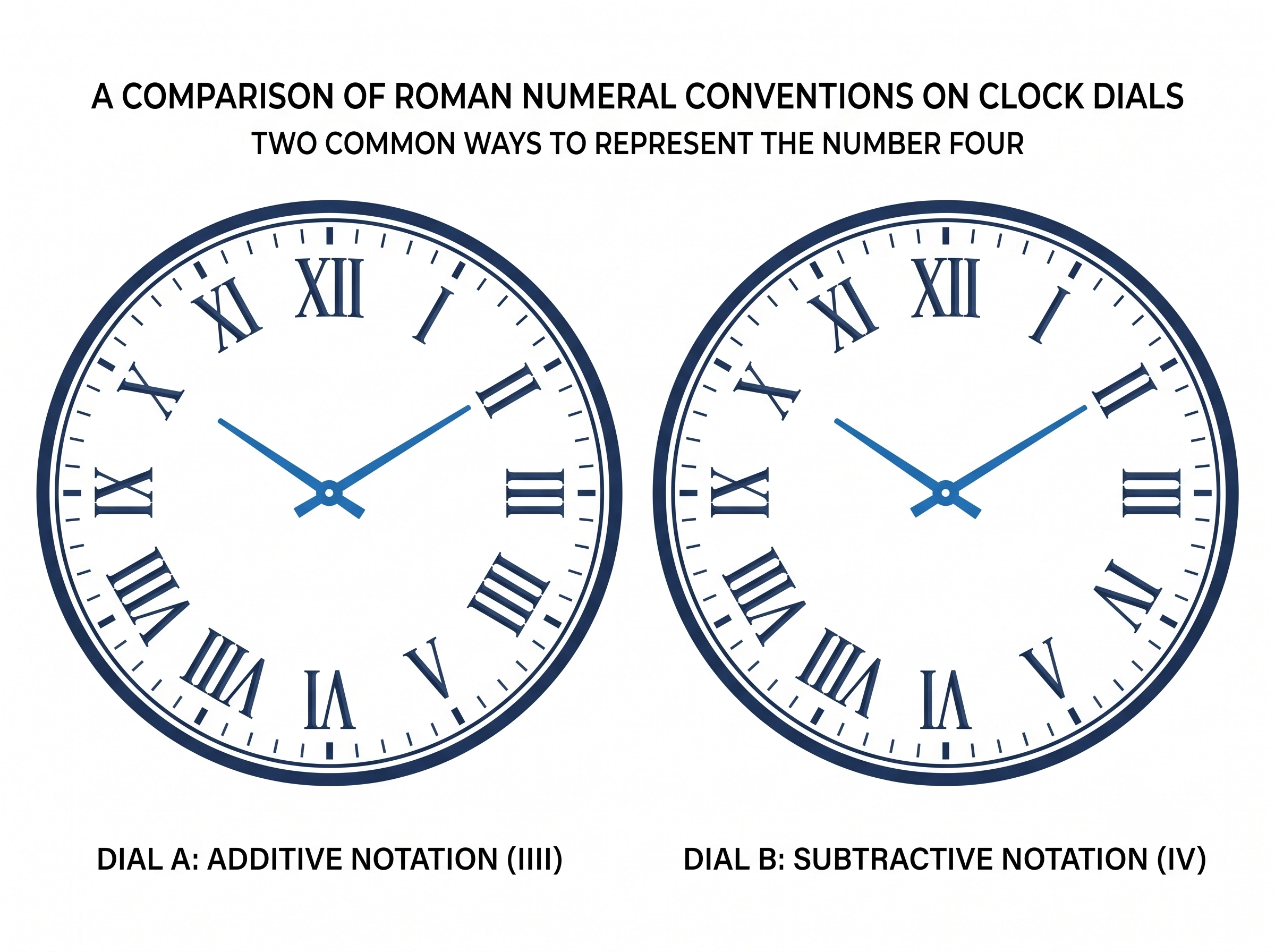
Pick up almost any watch or mantel clock with Roman numerals and the 4 will read IIII, not IV. This bothers people who have just learned the rules, and reasonably so, because by modern standards it is wrong.
Nobody knows the real reason, but a few explanations hold up better than others.
The strongest is visual balance. IIII has four characters, which sits opposite VIII on the dial and gives the face a symmetry that the two-character IV breaks. It also means the left third of the dial uses only I, the middle third introduces V, and the bottom third brings in X, which reads as a tidy progression.
A practical one concerns casting. If a clockmaker cuts the numerals from metal, IIII means the full set needs twenty I, four V and four X, which is one mould containing a V, five I and an X, cast four times. Switching to IV changes the counts and the mould economics get worse. Whether any clockmaker actually thought this way is unclear, but the arithmetic checks out.
There is also a literacy argument. Subtractive notation only became standard well after the Roman Empire fell, around the time mechanical clocks were spreading through Europe, and most people looking at a town clock could neither read nor do arithmetic. Counting four marks is easier than performing a subtraction, and IV and VI are easy to confuse at a distance and at odd angles. Some early clocks used VIIII for nine for the same reason.
The story you will see repeated most often is the Jupiter one: that IV was avoided because the Latin spelling of Jupiter began IVPPITER and putting a god’s name on a sundial was risky. It is a good story with a serious problem, which is that subtractive notation was not in general use during the period when Romans were worried about offending Jupiter. The timeline does not work.
Big Ben is the famous holdout. The Great Clock at Westminster uses IV, breaking with nearly every other clock dial you will encounter.
Where you still see them
Roman numerals survive in places where something wants to feel formal, permanent, or ceremonial. Monarchs and popes are numbered this way, which is why it is Charles III rather than Charles 3. Book chapters, play acts, and outline headings often use them, as do building cornerstones and the copyright date at the end of film credits.
The Super Bowl is the most visible modern example. The NFL started numbering games with Roman numerals at Super Bowl V in 1971, partly to avoid confusion, since the season starts in one calendar year and the game is played in the next. The tradition has held ever since with exactly one break: the fiftieth game in February 2016 was branded Super Bowl 50 rather than Super Bowl L, because the league’s brand team spent years deciding that a lone L looked weak as a logo compared to XLVIII or XLIX. They went back to Roman numerals the following season with Super Bowl LI, and February 2026 gave us Super Bowl LX.
Film sequels, Olympic Games, and the occasional street address round out the list. It is a small footprint for a system that ran European accounting for over a thousand years, but it is a durable one.
Past 3,999: the overline
Standard Roman numerals cannot express 4,000, because MMMM would need a fourth M. The workaround, which developed later and became common in medieval manuscripts, is the vinculum: a horizontal bar drawn above a letter to multiply its value by 1,000.
Under that system V with a bar is 5,000, X with a bar is 10,000, and M with a bar is 1,000,000. The normal rules then apply on top, so 4,000 is written as I and V both barred, reading as 5,000 minus 1,000. Bar a barred numeral and you multiply by a million, which in theory takes the system into the billions, though almost nobody ever needed to.
In practice, you will not meet these outside specialist contexts. Most converters, including ours, stop at 3,999, and that covers essentially every real use: years, dates, chapter numbers, and event numbering. If you need to write an overline in HTML, the combining overline character is ̅ placed after the letter, or you can use a CSS text-decoration: overline span.
Why there is no zero
The system has no symbol for nothing, and it does not need one. Because each letter carries a fixed value regardless of position, there are no empty columns to hold open. Writing 1,005 in our system requires two zeros to keep the 1 and the 5 in the right places. In Roman numerals it is simply MV, with nothing to pad.
Zero as a number arrived later, developed in Indian mathematics and transmitted to Europe through Arabic scholarship along with the positional decimal system that eventually replaced Roman numerals for arithmetic. That replacement was not about elegance. Try multiplying MDCCCXLVII by XXIII on paper and the reason becomes obvious within about a minute.
Frequently asked questions
What are the seven Roman numerals?
I is 1, V is 5, X is 10, L is 50, C is 100, D is 500, and M is 1,000. Every Roman numeral is built from those seven letters.
How do you write 4 in Roman numerals?
IV, using the subtractive rule: I placed before V means 5 minus 1. You will see IIII on clock faces, which is a design convention rather than the modern standard.
What is 2026 in Roman numerals?
MMXXVI. That breaks down as MM for 2,000, XX for 20, V for 5 and I for 1. 2025 was MMXXV and 2027 will be MMXXVII.
What is the largest Roman numeral?
In the standard system it is 3,999, written MMMCMXCIX. The limit exists because M cannot repeat a fourth time. Anything larger needs the overline notation, where a bar above a letter multiplies it by 1,000.
Is there a Roman numeral for zero?
No. The system assigns a fixed value to each letter regardless of position, so it never needs a placeholder for an empty column. Zero as a concept came later, from Indian mathematics.
Why is 99 not written as IC?
Subtraction works on place values, not on the number as a whole. Ninety is XC and nine is IX, so 99 is XCIX. On top of that, I can only be subtracted from V or X, never from C.
How do you write a date in Roman numerals?
Convert the day, month number and year separately, then separate them with dots or slashes. 14 February 2026 becomes XIV · II · MMXXVI in day-month-year order. Decide on your field order before committing to a tattoo or engraving, because III · IV is genuinely ambiguous.
Why does the Super Bowl use Roman numerals?
The NFL adopted them at Super Bowl V in 1971 to avoid confusion between the season and the calendar year the game is played in. The only exception was Super Bowl 50 in 2016, which used the Arabic numeral because the league decided a single L made for a weak logo.
The bottom line
Seven letters, and one comparison you repeat as you read left to right. If the next letter is smaller or the same, add. If it is bigger, subtract. Everything else on this page is detail hanging off that.
The part worth memorising is the six subtractive pairs, because nearly every mistake anyone makes is an invented seventh. IV, IX, XL, XC, CD, CM. Nothing else subtracts.
And if the number is going on a ring, a cornerstone, or your arm, check it twice against a converter that validates rather than guesses. Roman numerals are permanent by design, which is most of their appeal and all of their risk.
Check it before you commit
Convert in either direction, from 1 to 3,999. Invalid forms are rejected rather than silently corrected, which is exactly what you want when the answer is going on jewellery or skin.
Open the converterAlso useful: the date calculator and the number base converter.
Quick reference
Everything above, condensed. Bookmark this section if you only came for one number.
The seven letters
I=1, V=5, X=10, L=50, C=100, D=500, M=1,000.
The rule
Read left to right. Smaller or equal next letter, add. Larger next letter, subtract.
The six subtractive pairs
IV=4, IX=9, XL=40, XC=90, CD=400, CM=900. There is no seventh.
Repeat limits
I, X, C and M repeat up to three times. V, L and D never repeat and never subtract.
Converting
Split by place value, convert each part, join largest first. 1,847 = M + DCCC + XL + VII.
Dates
Convert day, month and year separately. Separate with dots. Fix your field order first.
Limits
Standard range is 1 to 3,999 (MMMCMXCIX). No zero. Above 3,999 needs an overline.
Clocks
IIII on a dial is a design convention, not an error. Big Ben uses IV.
Last reviewed August 2026. See how we review and our affiliate disclosure.