Eight fields decide whether your invoice is legal
The rest of an invoice is habit. German law names the parts it insists on, and the list is shorter than most templates suggest. This guide gives you the eight, the wording a small business must add, the storage rule, and the e-invoice date that actually applies to you.
Writing an invoice in Germany is not hard, but it is precise. A missing tax number or an absent supply date can cost your client the input-tax deduction, which is the point at which an invoice stops being your problem and becomes theirs. Everything below was read on the primary source, and where a common claim did not survive checking, this guide says so.
The short version
If you read nothing else, read this table. It is the whole compliance question behind an invoice in Germany for a one-person business, in the order the questions actually arrive.
| The question | The answer | Where it comes from |
|---|---|---|
| What must be on it? | Eight items: both parties, your tax number, issue date, a unique number, what you supplied, the supply date, the net split by rate, the rate and tax amount | § 14 Abs. 4 UStG |
| Must numbers run without gaps? | No. They must be unique, not consecutive | UStAE 14.5 Abs. 10 |
| Small invoices? | At 250 euros gross or less you may drop the number, the client’s address and the tax split | § 33 UStDV |
| Small business, no VAT? | Thresholds are 25,000 euros last year and 100,000 this year, measured net. A note on the invoice is now compulsory | § 19 UStG, § 34a UStDV |
| Can I write it in English? | Yes. VAT law sets no language requirement | no rule to the contrary in § 14 |
| Is a PDF an e-invoice? | No. A PDF is an “other invoice”, legally alongside paper | § 14 Abs. 1 Satz 4 UStG |
| Must I send e-invoices? | Not yet for most. Paper runs out end of 2026, or end of 2027 if your prior-year turnover was 800,000 euros or less. All in from 2028 | § 27 Abs. 38 UStG |
| Must I receive them? | Yes, since 1 January 2025. Everyone, including small businesses | § 14 UStG |
| How long do I keep it? | Eight years from the end of the year you issued it, in its original electronic format | § 14b UStG, § 147 AO |
The eight fields every invoice in Germany must carry
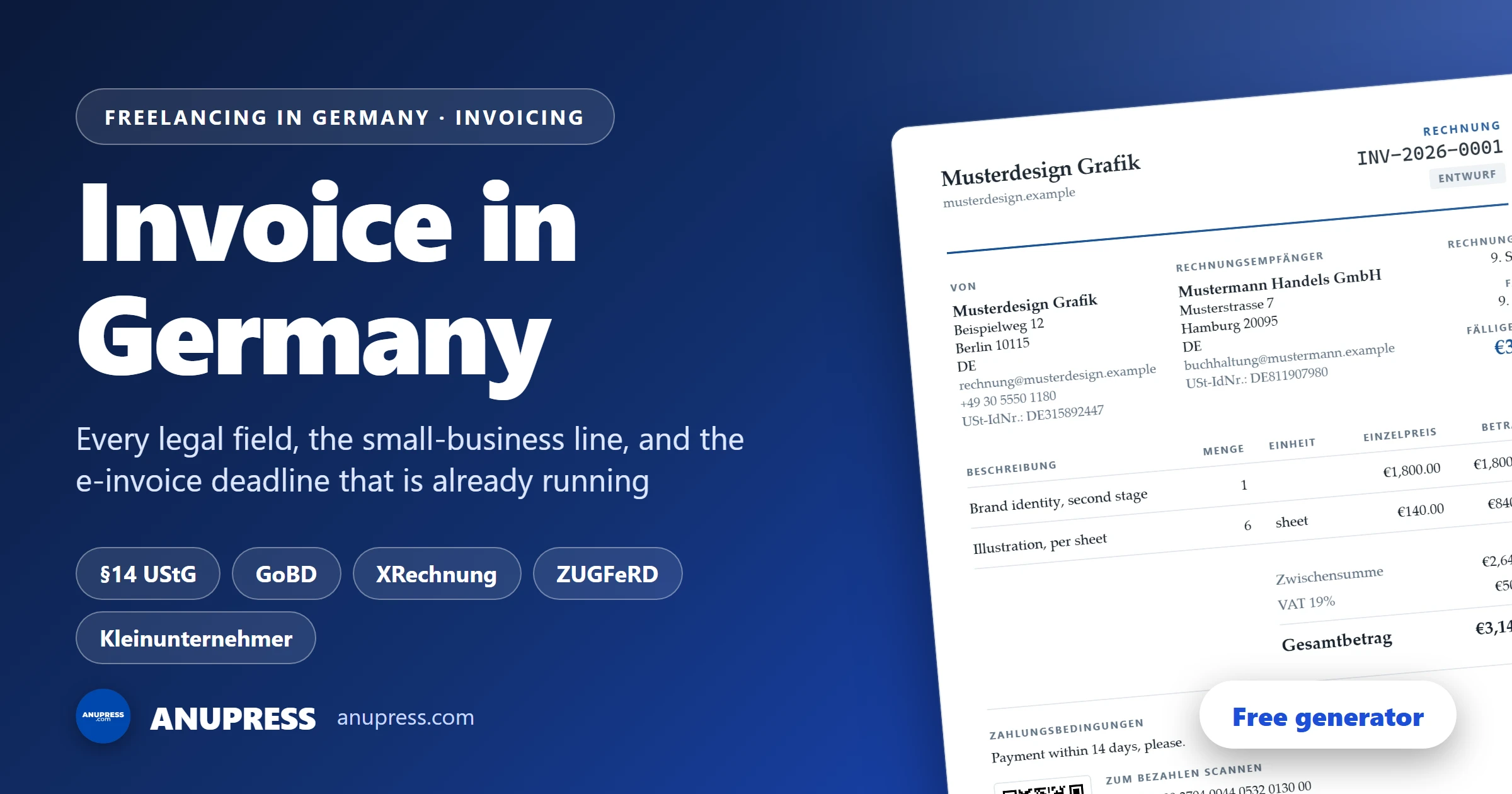
Section 14 paragraph 4 of the German VAT Act lists what a full invoice in Germany must contain. Two further items exist for narrow cases and are covered further down. These eight are the ones that apply to ordinary freelance work.
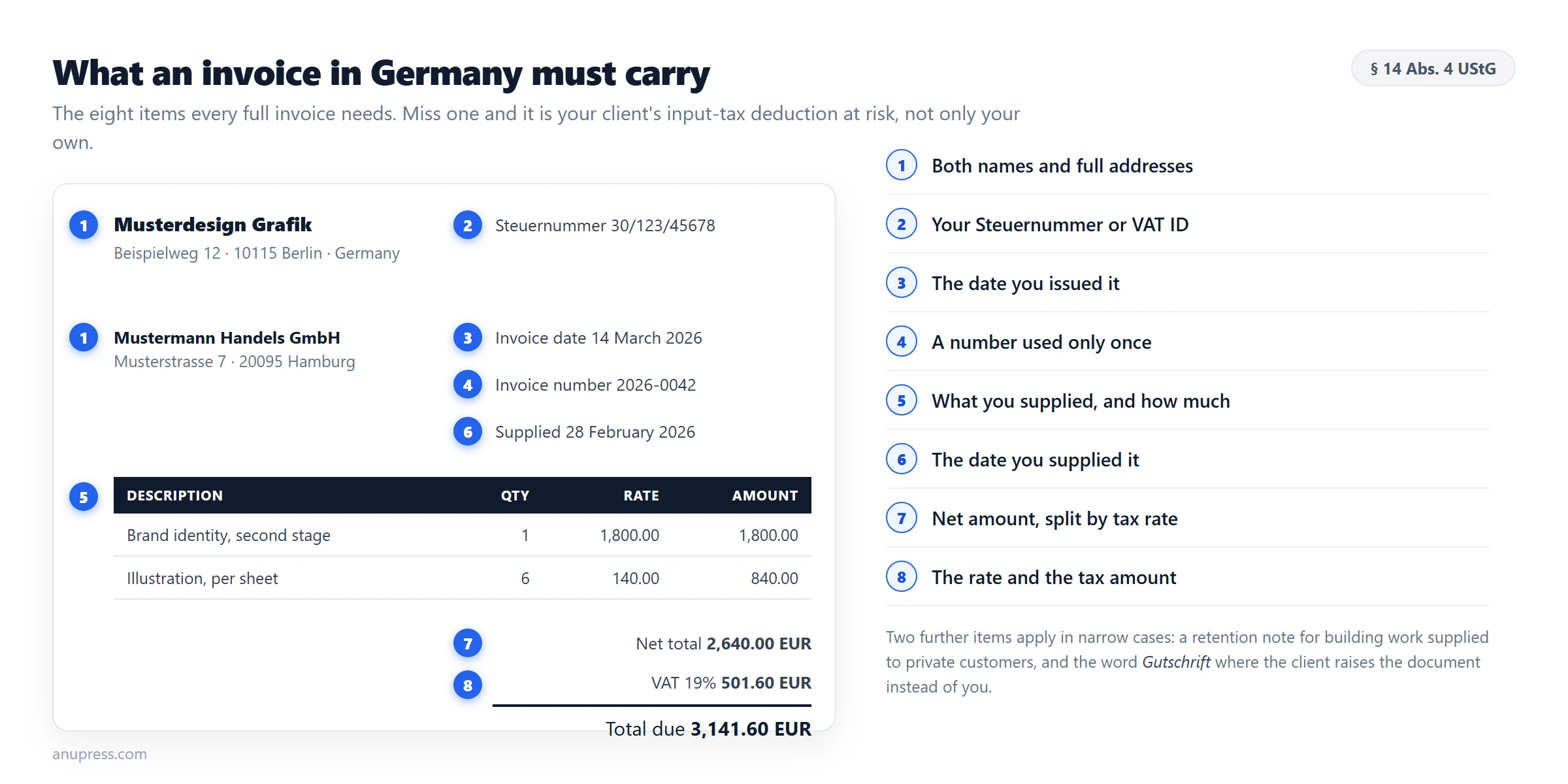
1. Both names, both full addresses
Your full name and address, and your client’s. The address has to be one where the party can actually be reached. This is the field that most often breaks on a freelancer’s invoice, because people abbreviate a company’s legal name or use a trading name that does not match the register. Write the name the client’s own paperwork uses.
2. Your Steuernummer or your VAT identification number
Either one satisfies the rule. The Steuernummer comes from your Finanzamt, the Umsatzsteuer-Identifikationsnummer from the Bundeszentralamt für Steuern. You do not need both. You need the VAT ID rather than the tax number as soon as you invoice a business in another EU country, for reasons covered below.
3. The date you issued it
The Ausstellungsdatum. Plain, and rarely wrong.
4. A number you have used once
The law asks for a number “issued once” to identify the invoice. It may combine several series, and it may mix letters with digits. It does not have to follow the previous one without a gap. That last point is often reported wrongly and it has its own section below.
5. What you supplied, and how much of it
The quantity and the commercially usual description of goods, or the scope and nature of a service. “Consulting” alone is thin. “Brand identity, second stage, 12 hours” is the level the rule is asking for, because the description is what lets an auditor decide the supply really happened.
6. The date you supplied it
The Leistungsdatum, and it is a separate requirement from the issue date even when the two are the same day. A month is enough where the work ran across one. An invoice that carries only one date is the second most common defect after a wrong company name, and it is usually fixed by a single line reading “Supplied in February 2026”.
7. The net amount, split by tax rate
Broken down by rate and by any individual exemption, plus any discount agreed in advance that is not already in the price. If everything on the invoice sits at 19 percent, this is one line.
8. The rate, and the tax amount in euros
The applicable rate and the tax that falls on the net amount, as a figure. Where the supply is exempt instead, you replace this with a note saying which exemption applies. You do not get to leave the space blank.
The invoice number myth
Section 14 paragraph 4 number 4 asks for a fortlaufende Nummer, a running number, which is why so many English guides report the rule as “consecutive”. That translation is fair. What the law does not require is an unbroken run, and that is the part guides often get wrong.
What section 14 paragraph 4 number 4 requires is a number issued once, using one or more series, so that the invoice can be identified. The administration’s own application decree, the Umsatzsteuer-Anwendungserlass, states at section 14.5 paragraph 10 that a gap-free run of invoice numbers is not compulsory. Separate ranges by year, by branch, by location or by organisational area are all permitted, and letters may be combined with digits.
Uniqueness is the requirement. Continuity is a convention, and no invoice in Germany is void for skipping a number.
Invoices of 250 euros or less
German law runs a lighter regime for small amounts, and it is genuinely lighter. Where the total is 250 euros gross or less, section 33 of the VAT implementing regulation asks for only four things: your name and address, the issue date, the quantity and type of what you supplied, and the amount together with the tax rate in one sum.
Read what is missing from that list. No invoice number. No client address. No split between net and tax. A receipt from a café is already a valid invoice in Germany, which is exactly why it can be booked as one.
The relief does not apply to intra-EU distance sales, intra-EU supplies of goods, or reverse charge cases. Those need the full document however small the amount.
If you are a Kleinunternehmer
The small-business rule in section 19 was rewritten with effect from 1 January 2025, and three things changed that matter on the face of your invoice in Germany.
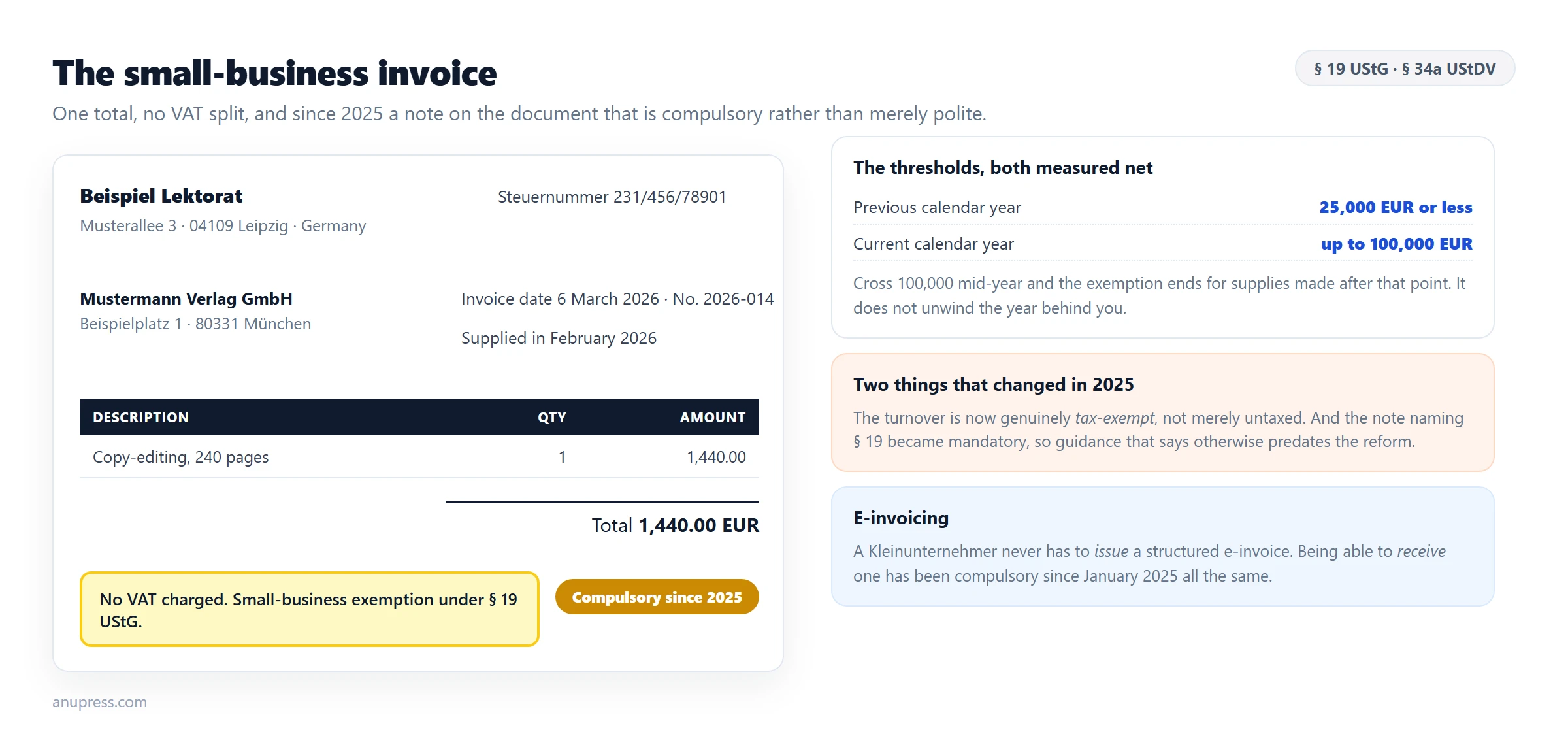
The thresholds moved. You qualify if your turnover was 25,000 euros or less in the previous calendar year and does not exceed 100,000 euros in the current one. Both figures are measured net. The old practice of adding a notional VAT before comparing is gone.
The character of the turnover changed. The statute now says the turnover is tax-exempt, where it used to say the tax was simply not collected. That sounds academic and is not: an exemption is a positive status your invoice can state.
The note on the invoice is now compulsory. Section 34a of the implementing regulation requires the amount in one sum together with a note that the small-business exemption under section 19 applies. No exact sentence is prescribed, so anything unambiguous works:
If you cross 100,000 euros mid-year, get this one right, because it costs money. The supply that crosses the line is itself already taxable in full. You charge VAT on that invoice, not from the next one onwards, and every supply after it is taxable too. What you had already invoiced before the crossing stays exempt, so it does not unwind the year behind you. Issue the crossing invoice without VAT and you will generally owe that VAT out of your own pocket.
When an invoice in Germany is compulsory
You are always entitled to issue an invoice in Germany. You are obliged to, within six months of doing the work, in three cases: the supply goes to another business for its business, or to a legal entity that is not a business, or the work is a building-related supply.
The case that surprises people is the one that is missing. For an ordinary private customer, with no building work involved, there is no statutory duty to issue an invoice at all. Most freelancers issue one anyway, because the client wants a record and so do you.
Where the duty does apply and you ignore it, it is an administrative offence carrying a fine of up to 5,000 euros. In practice the commercial consequence arrives first: a business client cannot deduct input tax without a compliant invoice, so an invoice that is late or wrong is a payment that is late.
Clients in another EU country
An invoice in Germany sent to a business in another member state changes three things at once, and all three are on the document.
- Both VAT identification numbers must appear, yours and your client’s. This is where the VAT ID stops being optional and the Steuernummer stops being enough.
- You show no German VAT, because the tax liability moves to the recipient. The rule that requires a separate tax figure is switched off for these supplies.
- You add the reverse-charge wording. The statutory phrase is Steuerschuldnerschaft des Leistungsempfängers. The English “reverse charge” is commonly accepted alongside it, and printing both costs nothing.
The deadline is tighter too. For cross-border services where the recipient owes the tax, the invoice is due by the fifteenth day of the month following the month you did the work, not six months later. You will also need to file a Zusammenfassende Meldung, a recapitulative statement, by the 25th day after each quarter.
E-invoicing: the deadline that actually applies to you
Germany is phasing in compulsory structured invoicing between businesses, so every invoice in Germany is heading for a machine-readable format. The phase-in is usually reported as “2025”, which is right about receiving and wrong about sending.
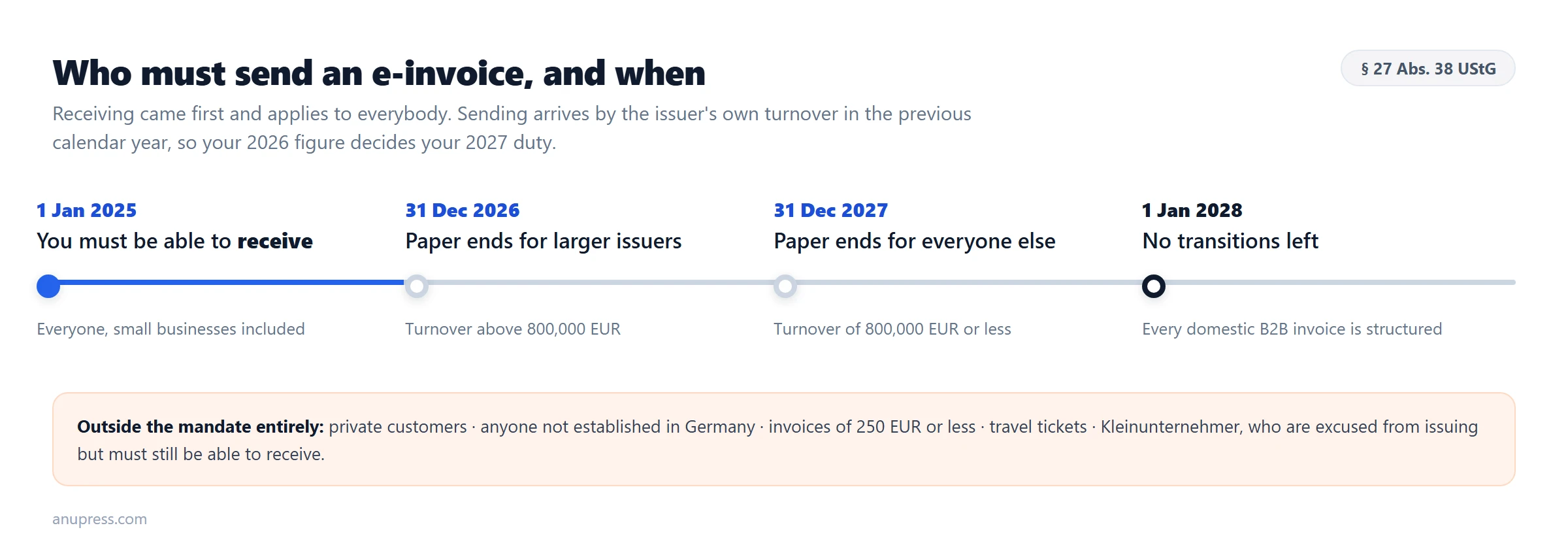
- Since 1 January 2025: you must be able to receive one. A domestic business may send you a structured e-invoice without asking permission, so the capability to accept one is now assumed. This applies to everybody, small businesses included. An email address that can take an XML attachment is enough to meet it.
- Until 31 December 2026: paper is still fine for sending. Paper is permitted outright. A PDF is not on the same footing: because it is an electronic format that does not comply, sending one needs the recipient’s agreement.
- Until 31 December 2027: an extra year, if you are small. The extension applies where your own total turnover in the previous calendar year was 800,000 euros or less. Your 2026 turnover decides your 2027 obligation.
- From 1 January 2028: no transitions left. Every domestic business-to-business invoice must be a structured e-invoice.
For a freelancer the practical reading is short. 2027 is the year to plan for if you turn over more than 800,000 euros, and 2028 if you do not. Neither is 2025, and neither is next week.
Where the mandate does not reach
The obligation is narrower than the coverage suggests, and four exclusions matter to freelance work:
- Private customers. An e-invoice to a consumer requires their consent. B2C is outside the mandate.
- Anyone not established in Germany. Both parties must be established here. Your client in Vienna or Vilnius is out of scope, whatever their own country requires of them.
- Invoices of 250 euros or less, and travel tickets. These may always be sent as an ordinary invoice.
- Kleinunternehmer. Small businesses are excused from issuing an e-invoice entirely. They must still be able to receive one.
XRechnung, ZUGFeRD, and what actually counts as an e-invoice
Since 2025 the law divides every invoice in Germany into two kinds, and the dividing line is not the one most people assume.
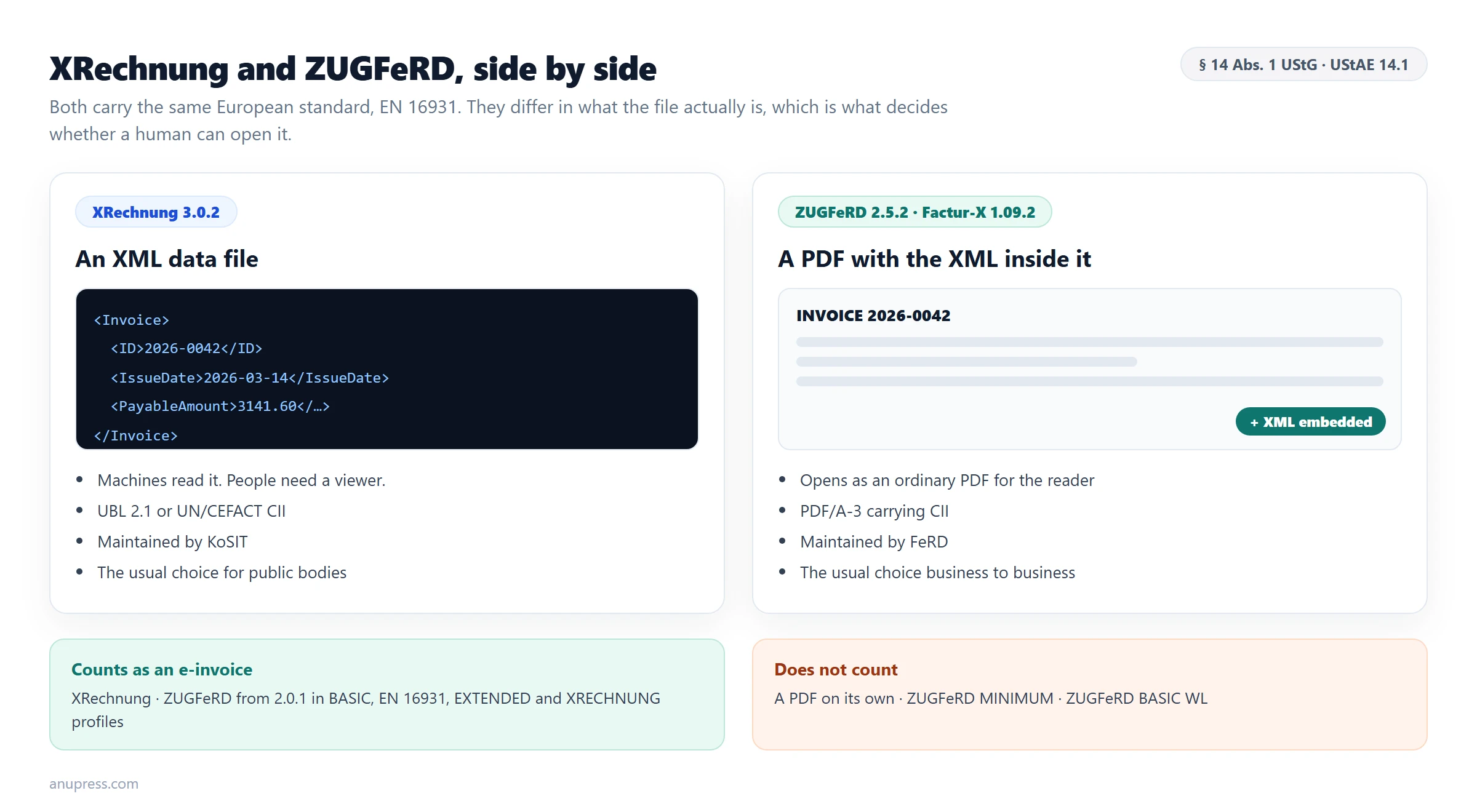
An e-invoice is issued, transmitted and received in a structured electronic format that permits electronic processing. Anything else, whether it arrives on paper or as a file, is a sonstige Rechnung, an “other invoice”. A PDF is an other invoice. It does not matter that it was produced by a computer, emailed, and looks immaculate. If the data cannot be read out of it by machine, it is a picture of an invoice.
| XRechnung | ZUGFeRD / Factur-X | |
|---|---|---|
| What the file is | An XML data file | A PDF/A-3 with XML embedded inside it |
| A human can read it | Not without a viewer | Yes, it opens as a normal PDF |
| Syntaxes | UBL 2.1 or UN/CEFACT CII | CII |
| Current version | 3.0.2 | 2.5.2, matching Factur-X 1.09.2 |
| Maintained by | KoSIT, for the IT-Planungsrat | FeRD, with its French counterpart |
| Typical use | Invoicing public bodies | Business to business |
| Satisfies the mandate | Yes | Yes, from version 2.0.1, except two profiles |
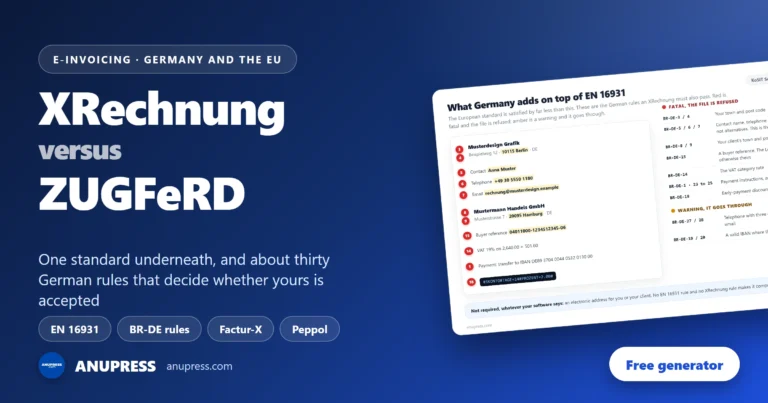
Both formats implement the same European standard, EN 16931. Peppol BIS Billing 3.0 restricts it, in the standard’s own vocabulary a Core Invoice Usage Specification. XRechnung does both at once: it restricts the standard, and it extends it with fields EN 16931 does not have, among them sub invoice lines and third-party payments. That shared base is why a file built for one can usually be read by the other.
Two things you probably do not need
A Leitweg-ID. This is a routing identifier that tells a public authority which unit an invoice belongs to, and it is required when invoicing public bodies, not between businesses. The authority issues it to you. Invoicing tools often show the field prominently enough to imply it is universal. For ordinary freelance work it is not.
Peppol. Peppol is a transport network, not a format, and Germany does not require it for business-to-business invoicing. The law prescribes no delivery channel at all. Email, a download portal, EDI or a shared folder are all acceptable, and the parties agree the route between themselves. Email with the file attached is a perfectly legal way to send an e-invoice.
Checking the file before you send it
A structured invoice in Germany either satisfies its rulebook or it does not, and you can find out in seconds rather than discovering it through a rejection two weeks later.
- In a browser, free, no registration: the European Commission hosts an online EN 16931 validator that takes your file and returns the rules it broke.
- On your own machine: the KoSIT validator checks XRechnung and other XML invoices and is the reference implementation. Mustangproject checks ZUGFeRD and Factur-X files, including the PDF container itself.
There is no official validator from the tax authority. The federal tax portal offers a viewer for looking at an e-invoice, which is a different thing, and several guides describe it as a validity check. It is not one.
Keeping an invoice in Germany: eight years
The retention period for an invoice in Germany is eight years, not ten. It was shortened with effect from 2025, and the shorter period applies to every invoice whose old period had not already expired on 31 December 2024. The clock starts at the end of the calendar year in which the invoice was issued, so an invoice from March 2026 is safe to delete in January 2035.
The format rule is the one that catches people. Under the GoBD, an electronic invoice must be kept in the format in which it was received. Printing an emailed invoice and filing the paper does not satisfy the requirement, and converting the file to an image is expressly not allowed to destroy the structured part.
There is a helpful recent clarification for hybrid files. For a ZUGFeRD invoice you need keep only the structured XML part. The readable PDF half must be kept as well only where it carries tax-relevant information the XML does not, such as a booking note added later.
Three GoBD principles do real work for a one-person business: records must be traceable and verifiable by a third party, complete and timely, and above all unalterable. A booking may not be changed in a way that leaves the original content unrecoverable. In practice that is an argument against keeping your invoice history as editable documents in a folder you can silently overwrite.
Making an invoice in Germany, free
All of the above is a specification, and a specification is something a tool should be handling for you. We built one that writes an invoice in Germany to these rules, and it is free.
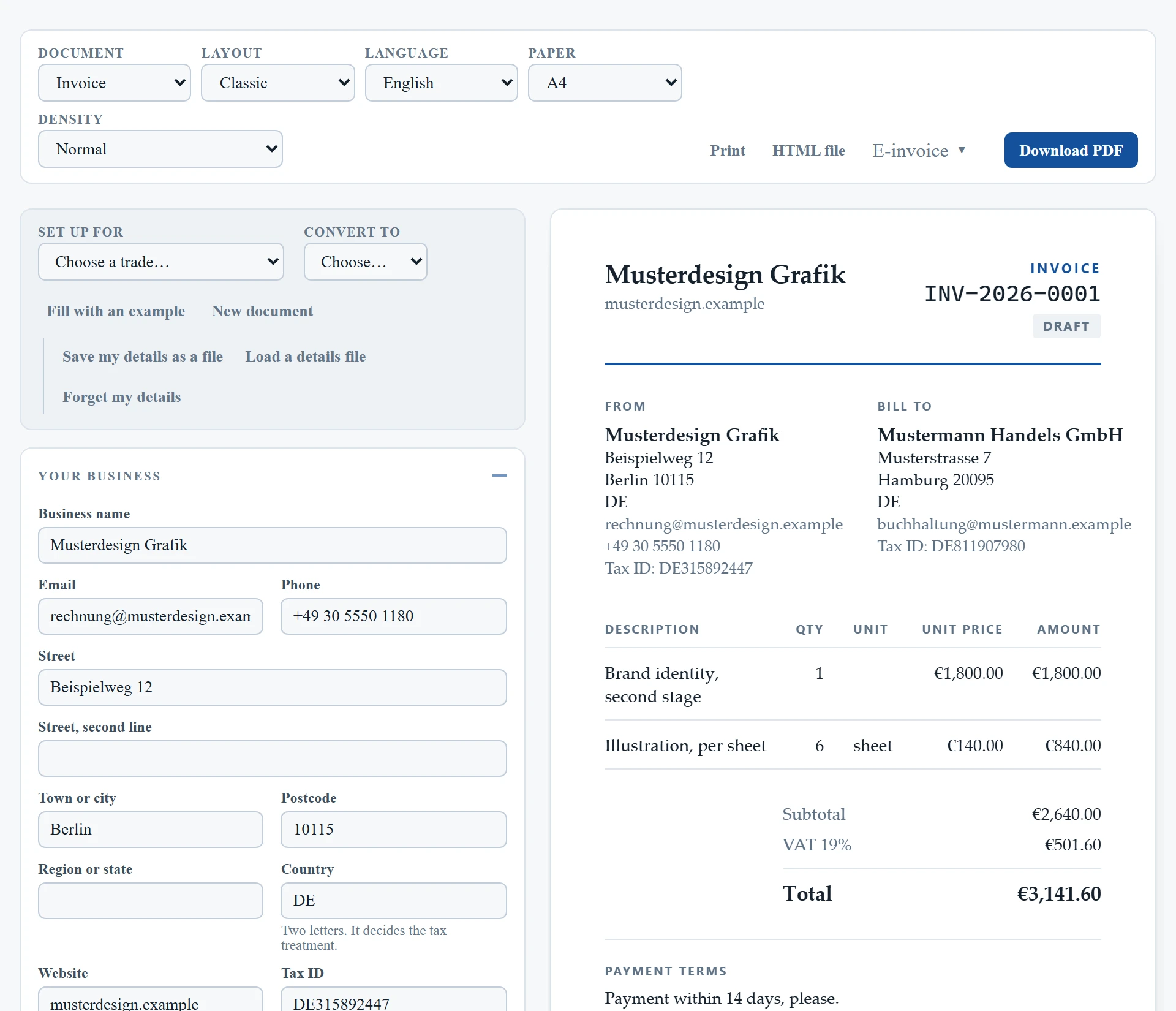
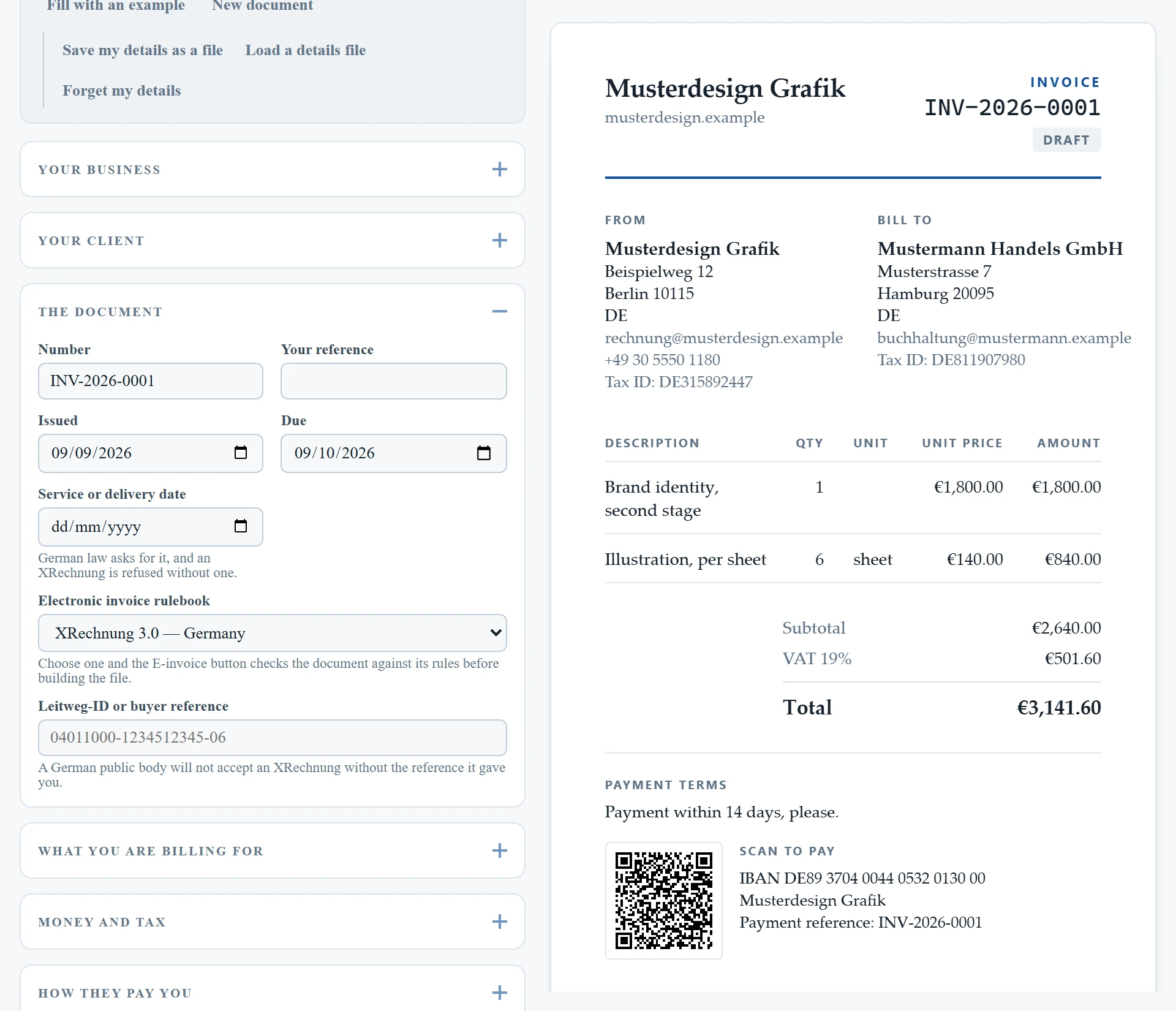
The ANUPRESS invoice generator runs entirely in your browser tab. There is no account, no sign-up, no limit on how many invoices you make and no watermark on any of them. The document is drawn on your own machine, so nothing you type reaches our server unless you choose to use the optional “Email it” button, which sends the invoice through our mail relay. For the fields above that means the layout already carries the required items and prompts you for the ones people forget, the supply date in particular.
It does the German-specific parts too:
- Every output format the mandate accepts. PDF for today, and XRechnung 3.0, Factur-X, UBL and CII when a client asks for a structured file.
- The small-business wording, generated in the right place with the right statutory reference when you set your business up as a Kleinunternehmer.
- Reverse charge worked out from the two addresses, so an EU business client gets the right wording and no German VAT.
- A rule check before the file is built. Rulebook errors block the download and name the rule, rather than letting you send something that will bounce.
- The document in your client’s language, German included.
Open the free invoice generator
Where this guide stops
Naming the limits is more useful than pretending there are none.
This is not tax advice. It is a reading of the statutes behind the invoice in Germany, each linked so you can check the wording yourself. Your own facts can change the answer, and a Steuerberater is the person who can apply the rules to them. That is worth saying plainly rather than in a footer.
Income tax and trade tax are not covered here. This guide is about the invoice document under VAT law. Whether your work counts as freelance or as a trade, what that means for trade tax, and how you are assessed are separate questions with separate rules.
Some things could not be verified and are therefore absent. A widely quoted suffix said to be added to small-business VAT identification numbers does not appear in the statutory text, so it is not in this guide. Neither is the trade tax allowance figure, which is repeated constantly but which we did not read on the primary source. The defensible position is to leave both out.
The federal states have their own public-sector rules. The B2G section covers the federal level. If you invoice a municipality or a state authority, its portal and its deadlines are its own.
Invoice in Germany FAQ
Does an invoice in Germany have to be written in German?
No. German VAT law sets no language requirement for an invoice, so an English invoice is as valid as a German one. Two practical cautions. A tax office may ask for a translation during an audit, and some accounts departments will simply pay a German document faster because nobody has to think about it.
Do my invoice numbers have to run without gaps?
Not gapless, no. Section 14 paragraph 4 number 4 of the VAT Act asks for a fortlaufende Nummer, a running number, which is why many English guides translate the rule as consecutive. That much is fair. What the law does not require is an unbroken run: the tax administration says in its own application decree, section 14.5 paragraph 10, that a gap-free run of invoice numbers is not required. You may use separate number ranges per year, per client type or per branch, and you may mix letters with digits.
Is a PDF an e-invoice in Germany?
No. Since 2025 the law splits invoices into two kinds. An e-invoice is issued, sent and received in a structured electronic format that a machine can process. Everything else, including a PDF and a paper invoice, is a sonstige Rechnung, an other invoice. A PDF with an invoice picture in it is legally in the same box as paper.
Do I have to send e-invoices yet as a freelancer?
Probably not yet, but you must already be able to receive one. Receiving has been compulsory since 1 January 2025. For sending, paper is still allowed until the end of 2026, and until the end of 2027 if your own turnover in the previous calendar year was 800,000 euros or less. From 1 January 2028 every domestic business-to-business invoice must be an e-invoice. Small-business owners under the Kleinunternehmer rule are excused from sending one at all.
What must a Kleinunternehmer write on an invoice?
You show one total with no VAT split, and you must add a note saying the small-business exemption under section 19 applies. Since the 2025 reform that note is compulsory rather than merely advisable, and the turnover is genuinely tax-exempt rather than untaxed. No exact sentence is prescribed. Something as plain as: no VAT charged, small-business exemption under section 19 UStG, does the job.
How long do I have to keep my invoices in Germany?
Eight years, counted from the end of the calendar year in which you issued the invoice. The period was shortened from ten years and the shorter rule applies to every invoice whose period had not already run out on 31 December 2024. Keep the electronic file itself. A printout of an invoice you received electronically does not satisfy the rule.
Do I need a Leitweg-ID on my invoices?
Only when you invoice a public body. The Leitweg-ID is a routing number that tells a public authority which unit inside it the invoice belongs to, and the authority gives it to you. Ordinary business-to-business invoices never need one, which is worth knowing because e-invoicing tools often present the field as though it were compulsory.
Can I check an e-invoice for free before I send it?
Yes. The European Commission runs a free online validator that takes an invoice file in your browser with no registration. For files on your own machine, the KoSIT validator checks XRechnung and other XML invoices, and Mustangproject checks ZUGFeRD files including the PDF container. Keep the validation report: the tax administration now accepts that a business acting with ordinary care may rely on a validation result.
Bottom line
Get the eight fields right and the rest of the invoice in Germany question mostly answers itself. Put both parties on the document with real addresses, your tax number, two dates rather than one, a number you have not used before, a description an auditor could believe, and the money split by rate. That is a legal invoice in Germany.
Then hold three dates in your head. You have had to be able to receive an e-invoice since January 2025. You will have to send them from 2027 if you are above 800,000 euros of turnover and from 2028 if you are not. And you keep every one of them for eight years, in the format it came in.
If you want the document itself handled, use the free invoice generator. It is the tool we would point anyone writing their first invoice in Germany at, because it produces both the PDF you need this week and the XRechnung a client will ask for later, it costs nothing, and it never sees your data. For the underlying law, every section above names the statute it relies on, so you can look up the wording yourself rather than take our word for it.
Written by the ANUPRESS team. Every legal figure in this guide was read on the official statute text on 9 September 2026. Rules change, and this guide is information rather than tax advice. Found something out of date? Tell us and we will check it.