By ANUPRESS Team · Last reviewed August 2026 · 9 min read
Foreign transaction fees typically run 1–3% of every purchase, and a small number of cards charge nothing at all. On €1,500 spent abroad in a month, that gap is the difference between paying €0 and paying up to €45, and it repeats every single month you travel or shop from a foreign site. Spend that much abroad monthly for a year and a typical UK card costs you roughly €495 more than a fee-free one, for the exact same purchases.
The numbers below all came from running real amounts through our own foreign transaction fee calculator, using the fee tiers it already tracks for major card types, so every figure here is one you can reproduce yourself with your own spending numbers.
On this page
What a foreign transaction fee actually is
Every time you pay in a currency other than your card’s billing currency, up to two separate charges can apply, bundled into one line on your statement. The card network, Visa or Mastercard typically, takes a small cut for converting the currency, usually around 1%. On top of that, your card issuer adds its own markup, and that markup is the part that varies wildly between a fee-free card and one charging 3%. When your statement shows a single “foreign transaction fee” percentage, you’re looking at both charges already combined into one number.
Foreign transaction fees compared, by card type
These five tiers cover most cards in circulation, and they’re the exact benchmarks built into our calculator below, so the number you see here is the number you’ll get testing your own spending.
The gap between the top and bottom of that list isn’t trivial. It’s the entire fee, every single time you pay, and it never announces itself as a separate line item the way a delivery charge does, it’s just quietly folded into the converted amount you see on your statement.
Two real spending patterns, priced out
Round numbers rarely match real spending, so here are two patterns that do: a monthly traveler moving a meaningful amount, and a weekly cross-border spender moving very little each time but doing it constantly.
| Card | Fee | Cost per €1,500 | Cost per year (monthly) |
|---|---|---|---|
| Revolut / Wise / Monzo | 0% | €0.00 | €0.00 |
| Typical EU bank | 1.75% | €26.25 | €315.00 |
| Typical UK debit/credit | 2.75% | €41.25 | €495.00 |
| Amex (typical) | 2.99% | €44.85 | €538.20 |
| Typical US card | 3% | €45.00 | €540.00 |
Pattern: €1,500 spent abroad, about every month, for a year.
The smaller, constant pattern matters too
A weekly €80 purchase abroad, a cross-border commute, a subscription billed in another currency, adds up quietly. On a typical UK card at 2.75%, that’s €2.20 a week, which sounds negligible until you annualise it: roughly €114 a year, for purchases too small to ever notice individually.
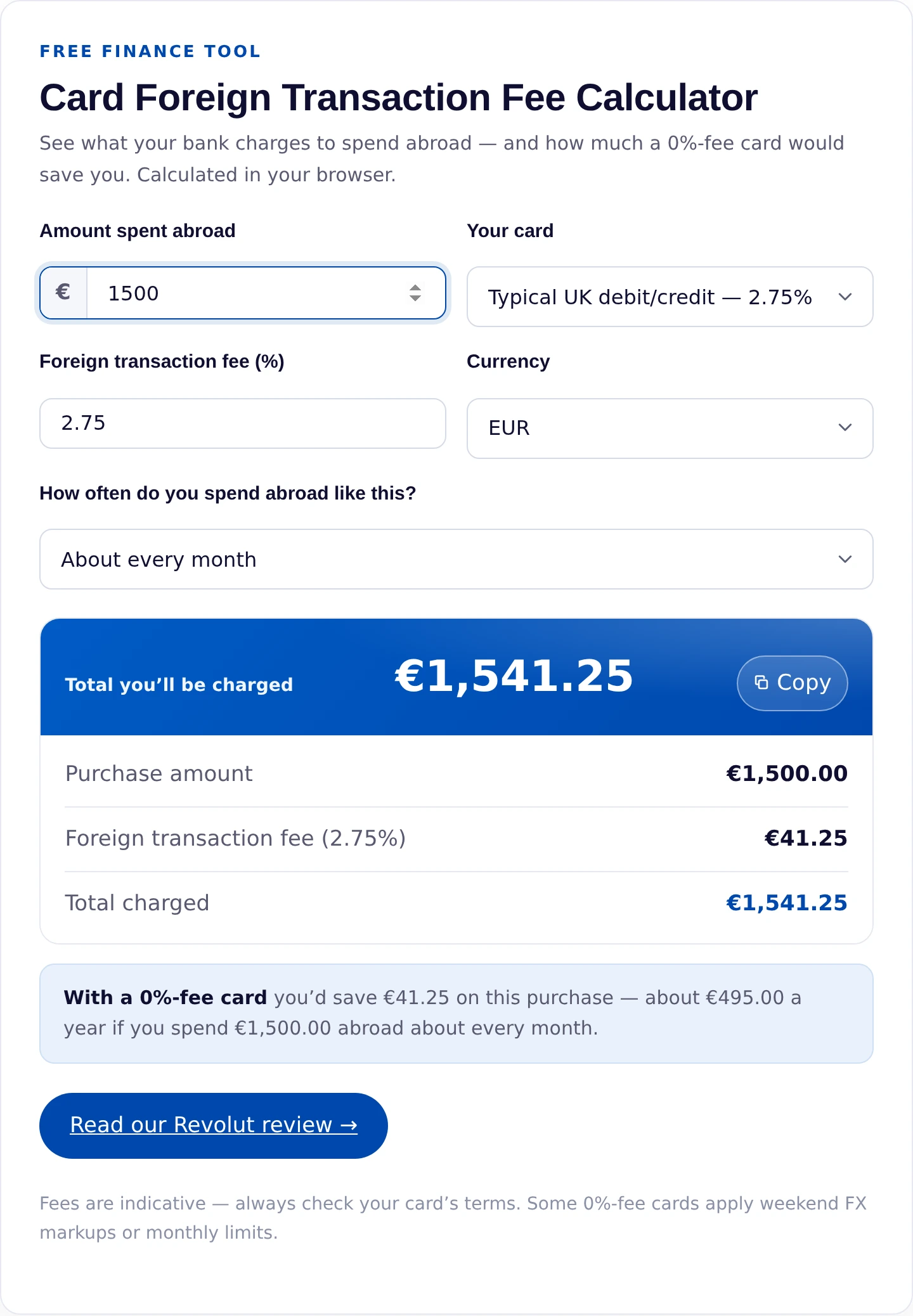
Price your own card and spending pattern
Enter your actual card’s fee, your typical spend, and how often you travel or shop abroad, and see the exact annual cost, plus what switching to a 0%-fee card would save you.
Open the foreign transaction fee calculatorThe catch behind “0% fee” cards
A genuinely fee-free card on paper can still cost you money in practice, and the fine print is where it happens. Our own long-term Revolut review found three specific rules on its free plan worth knowing before you assume 0% means 0% in every situation: weekday exchanges are free and at the real interbank rate, but only up to a monthly allowance (€1,000 in Germany); above that allowance a small percentage applies; and weekend exchanges carry a flat 1% fee regardless of the allowance, because currency markets are closed and the rate risk gets passed to you.
None of that makes a 0%-marketed card a bad choice, it’s still meaningfully cheaper than a 2.75% card in ordinary use. It does mean “0% fee” is a headline, not a guarantee, and the practical fix costs nothing: convert on a weekday, and keep an eye on the monthly allowance if you’re moving larger sums. The full breakdown of exactly when Revolut’s free plan does and doesn’t charge is in the complete Revolut free plan review.
How to actually avoid the fee
| Situation | What actually helps |
|---|---|
| Occasional traveler | A free digital-bank card for trips is enough; no need to switch your main account |
| Frequent traveler or expat | A 0%-fee account as a genuine second account, main banking stays where it is |
| Paying a foreign card terminal or ATM | Always choose to pay in the local currency, never your home currency; that “convenient” home-currency option is dynamic currency conversion, and its rate is always worse |
| Recurring foreign subscription or invoice | Route it through whichever card has the lowest fee for that specific currency; a single 3% card used for everything is the most expensive default there is |
If you’re weighing this specifically as an expat or long-term mover rather than an occasional traveler, the wider account setup, not just the card fee, matters more, covered in the Credit Cards in Germany guide.
Frequently asked questions
What’s a typical foreign transaction fee?
Most cards charge between 1% and 3% of each transaction, with the average sitting around 1.5-2%. A growing number of cards, mostly digital-first banks and some travel-focused credit cards, charge 0%.
Is a foreign transaction fee the same as a bad exchange rate?
No, and the difference matters. The fee is a clear percentage added to the converted amount. A bad exchange rate is a hidden markup baked into the conversion itself, most often via dynamic currency conversion at a terminal or ATM, and it can cost more than the stated fee while looking like a convenience.
Do debit cards charge foreign transaction fees too?
Often, yes, at similar rates to credit cards. The fee is set by the card issuer, not by whether the card is debit or credit, so a 2.75% debit card and a 2.75% credit card cost identically on a foreign purchase.
Are foreign transaction fees charged on online purchases from foreign websites?
Yes. The fee triggers based on where the transaction processes, not your physical location, so buying from a foreign online retailer while sitting at home still counts as a foreign transaction on most cards.
Is a 0%-fee card always the cheapest option?
In ordinary weekday use, generally yes. The exceptions are monthly exchange allowances and weekend surcharges that some 0%-marketed cards still apply, which is why it’s worth reading the specific terms rather than trusting the headline rate alone.
Fee tiers shown are typical figures for illustration; always check your own card’s current terms, which can change without notice. Last reviewed August 2026. See how we review and our affiliate disclosure.