By ANUPRESS Team · Last reviewed August 2026 · 32 min read
This page is a working reference for the math formulas most people actually need, each one explained in plain English, then written out again as plain text you can copy straight into a note, a spreadsheet cell, or your own homework. Fourteen topics, from the order of operations to quadratic equations, each with worked examples we checked by running the numbers rather than typing them from memory, and a link to the calculator that does it instantly once you understand how.
Most math references pick a lane. They cover algebra, or they cover geometry, or they turn every fraction into its own thin page. This one treats those math formulas as one connected system instead of splitting hairs that way. It follows the order most people actually rebuild their math in when they are relearning it as an adult: how to read an expression correctly, how to work with fractions and percentages, how to solve for an unknown, how to measure a shape, how to describe a set of numbers, and how numbers themselves can be written in more than one base.
Every section stands on its own, so jump straight to what you need from the list below. Every formula sits in a copy button. Every calculator link is the actual tool, not a demo.
On this page
- Order of operations (PEMDAS)
- Negative numbers
- Fractions
- Percentages
- Ratios and proportions
- Factors, GCF, LCM and primes
- Exponents and roots
- Solving linear equations
- Solving quadratic equations
- Geometry: area and perimeter
- Statistics: mean, median, mode
- Binary, octal, hex and decimal
- Multiplication tables
- Unit conversion
- Frequently asked questions
- Quick reference: every math formula
Order of operations (PEMDAS)
Before any of the math formulas below make sense, you need to agree on the order a mixed expression gets solved in. Without a fixed order, 3 + 4 × 2 could mean 14 or 11 depending on who is reading it, and math cannot work if the same expression has two right answers. PEMDAS is that fixed order.
The part almost everyone gets wrong is treating multiplication as strictly before division, or addition as strictly before subtraction. They are not ranked against each other. Multiplication and division share a tier and resolve left to right in the order they appear, and the same goes for addition and subtraction. BODMAS, the version taught in the UK, India and Australia, is the identical rule with different letters: Brackets, Orders, Division and Multiplication, Addition and Subtraction.
Walk through 2 + 3 × (4² − 1) ÷ 5. Parentheses first: 4² is 16, minus 1 is 15, so the expression is now 2 + 3 × 15 ÷ 5. No more brackets or exponents, so multiplication and division run left to right: 3 × 15 is 45, then 45 ÷ 5 is 9. That leaves 2 + 9, which is 11.
Two more worked examples
- 3 + 4 × 2 − (6 ÷ 3) → brackets first: 6÷3=2 → 3 + 8 − 2 → 9
- (8 − 3) × 2² → brackets first: 5 → exponent: 2²=4 → 5 × 4 → 20
A calculator that does not respect this order will happily give you the wrong answer for a correctly typed expression, which is the whole reason scientific calculators exist as a distinct category from basic ones.
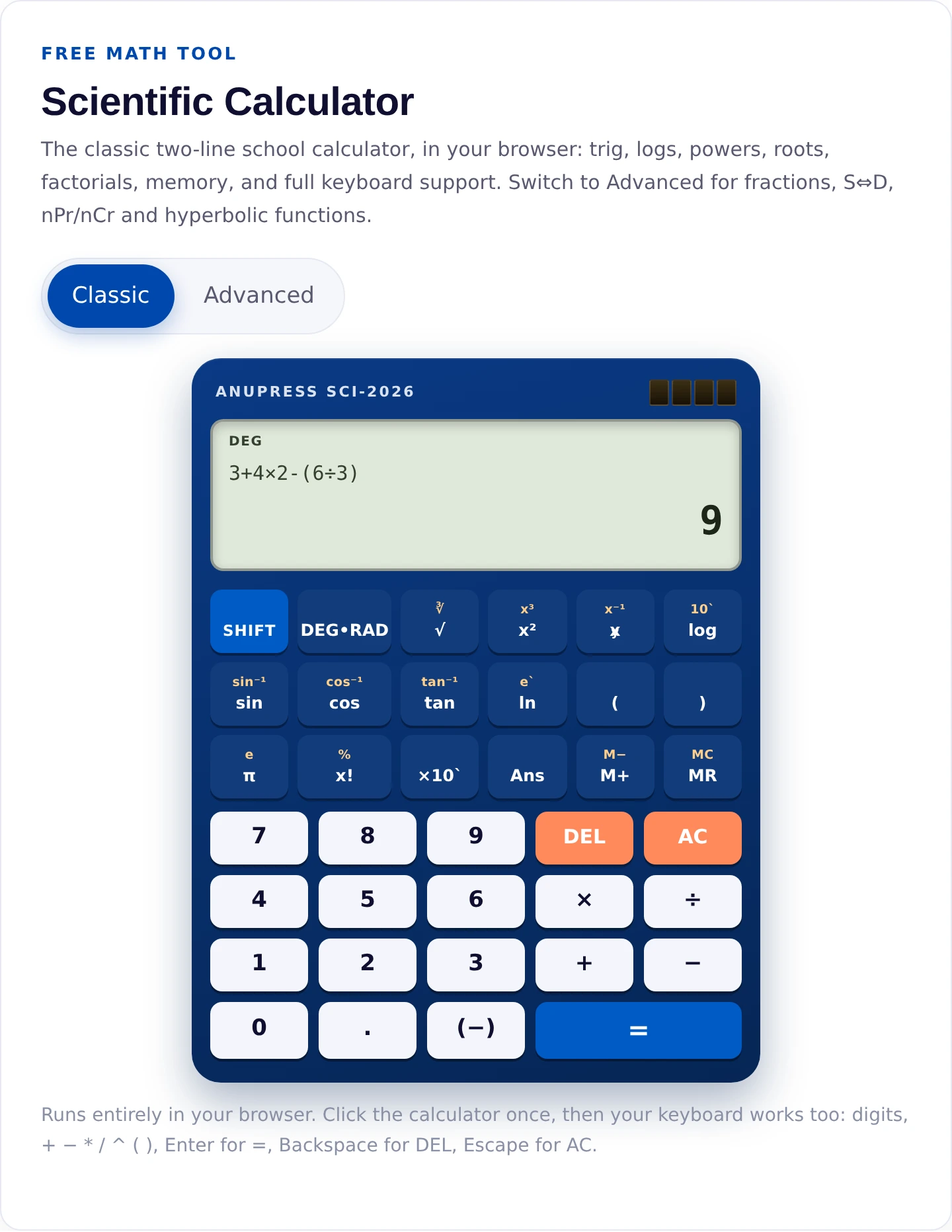
Type the whole expression, get the right answer
Our free scientific calculator applies PEMDAS automatically, handles trig, logs, powers and roots, and includes an advanced mode with fraction entry and permutations. Full keyboard support, no ads.
Open the scientific calculatorNegative numbers
Negative numbers trip people up not because the rules are complicated, but because there are four operations and the sign rules are not the same for all of them. Addition and subtraction depend on which number is bigger. Multiplication and division depend only on how many negatives are involved.
The reason multiplying two negatives gives a positive is easiest to see by pattern rather than by proof. Look at 3 × (−2), 2 × (−2), 1 × (−2), 0 × (−2): the results are −6, −4, −2, 0, going up by 2 each time. Keep the pattern going to −1 × (−2), and it has to be 2, not −2, for the pattern to hold. That single step is the whole rule.
On a number line, adding moves right and subtracting moves left, and a negative number simply reverses whichever direction you were about to move. −5 + (−3) starts at −5 and moves 3 further left, landing on −8. −20 ÷ (−4) is 5, since two negatives cancel; −20 ÷ 4 is −5, since only one sign flips.
Fractions
A fraction is a division that has not been carried out yet. 3/4 means exactly what 3 ÷ 4 means, and every rule below follows from treating it that way rather than as a separate kind of object.
Simplifying a fraction
Divide the top and bottom by their greatest common factor. 18/24 simplifies because both numbers share a factor of 6: 18 ÷ 6 is 3, and 24 ÷ 6 is 4, so 18/24 reduces to 3/4. A fraction is fully simplified when the numerator and denominator share no common factor beyond 1.
Equivalent fractions
Multiply the top and bottom by the same number and the value does not change, because you are really just multiplying by 1 in disguise (2/2, 3/3, and so on). 1/2, 2/4, 3/6, 4/8 and 5/10 are all the same value written five different ways.
The four operations
Adding and subtracting are the only two operations that need a shared denominator, and that is also the only step people skip when they get a wrong answer. Multiplying and dividing never require matching denominators at all, which is the opposite of what the addition rule trains you to expect.
Fractions, decimals and percentages
These are three notations for the same value, and converting between them is one calculation each way: divide to get a decimal, multiply the decimal by 100 to get a percentage.
| Fraction | Decimal | Percent |
|---|---|---|
| 1/2 | 0.5 | 50% |
| 1/3 | 0.3333… | 33.33…% |
| 2/3 | 0.6667… | 66.67…% |
| 1/4 | 0.25 | 25% |
| 3/4 | 0.75 | 75% |
| 1/5 | 0.2 | 20% |
| 2/5 | 0.4 | 40% |
| 3/5 | 0.6 | 60% |
| 4/5 | 0.8 | 80% |
| 1/6 | 0.1667… | 16.67…% |
| 5/6 | 0.8333… | 83.33…% |
| 1/8 | 0.125 | 12.5% |
| 3/8 | 0.375 | 37.5% |
| 5/8 | 0.625 | 62.5% |
| 7/8 | 0.875 | 87.5% |
| 1/10 | 0.1 | 10% |
| 1/12 | 0.0833… | 8.33…% |
Notice the thirds, sixths and twelfth: 1/3 does not settle into a clean decimal, it repeats forever as 0.3333… That is not a rounding error, it is a genuine property of the fraction, and it is why 33% and 1/3 are close but not identical. For anything with a denominator of 3, 6, 7, 9 or 11, expect a repeating decimal rather than one that terminates.
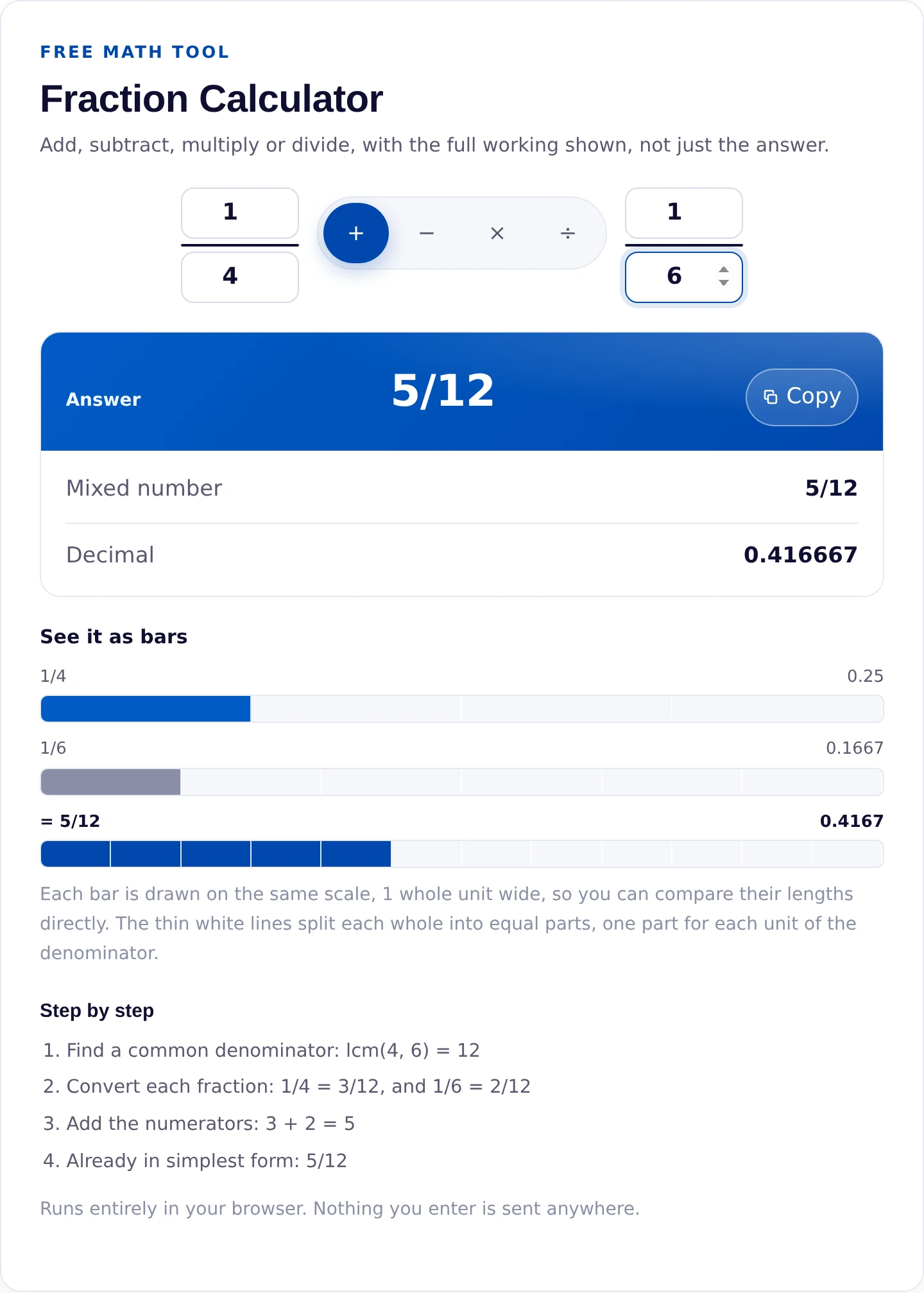
See every step, not just the answer
Our fraction calculator adds, subtracts, multiplies and divides, and shows the full working alongside the simplified fraction, the mixed number, and the decimal equivalent.
Open the fraction calculatorPercentages
Percent means “per hundred”, so a percentage is a fraction with 100 permanently fixed as the denominator. Nearly every percentage question you will ever face is one of three shapes: finding a percentage of a number, finding what percentage one number is of another, or finding the whole from a part and a percentage.
Percentage change is where the most common mistake lives: the formula always divides by the old value, not the new one, and the direction is not symmetrical. Going from 80 to 92 is a 15% increase, but going back from 92 to 80 is not a 15% decrease. It is roughly a 13% decrease, because you are now dividing the same 12-point drop by the larger starting number of 92 instead of 80.
Percentage points are a separate trap. If an interest rate moves from 5% to 7%, that is a 2 percentage point increase, described in absolute terms. Described relatively, as a percentage change, it is a 40% increase, because 2 is 40% of the original 5. Financial and political reporting mixes these up constantly, on purpose or not, and the two numbers can look wildly different for the same event.
Common fraction-to-percent conversions worth memorising
- 1/4 = 25%, 1/2 = 50%, 3/4 = 75%
- 1/5 = 20%, 2/5 = 40%, 3/5 = 60%, 4/5 = 80%
- 1/3 ≈ 33.3%, 2/3 ≈ 66.7% (both repeat forever)
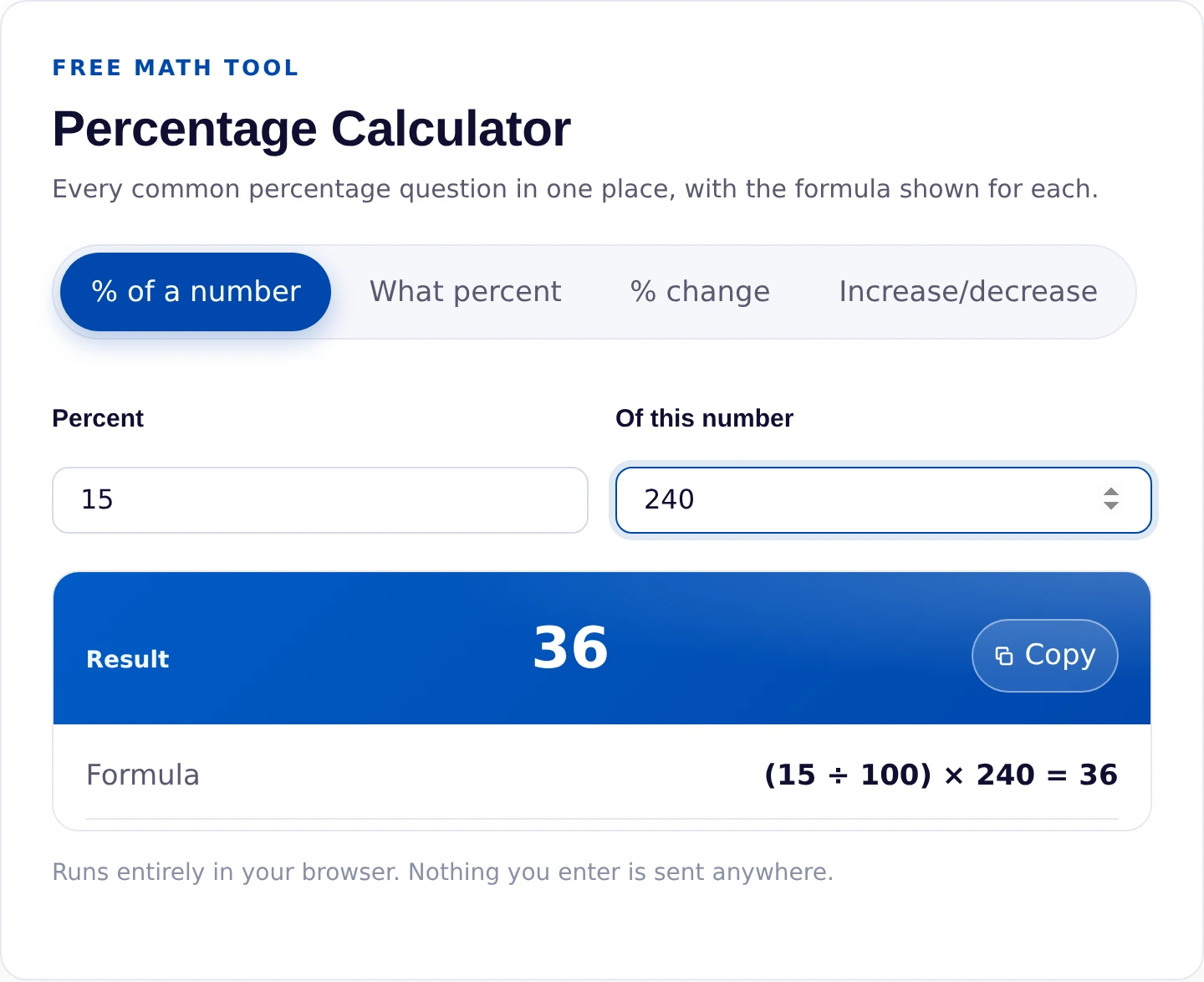
All four percentage question types, solved instantly
Our percentage calculator covers X% of Y, percentage change, and increasing or decreasing a number by a percentage, with the formula shown for every result.
Open the percentage calculatorRatios and proportions
A ratio compares two quantities directly, like 3:4, rather than describing one as a fraction of a combined whole. A proportion is a statement that two ratios are equal, and solving one almost always comes down to cross-multiplication.
Ratios show up constantly outside the classroom: a recipe scaled from 4 servings to 10, a map’s scale bar, paint mixed in a fixed proportion, aspect ratios on a screen. The proportion method (cross-multiply, then divide) works identically regardless of what the numbers represent, which is the entire appeal of learning it as an abstract skill rather than memorising it per situation.
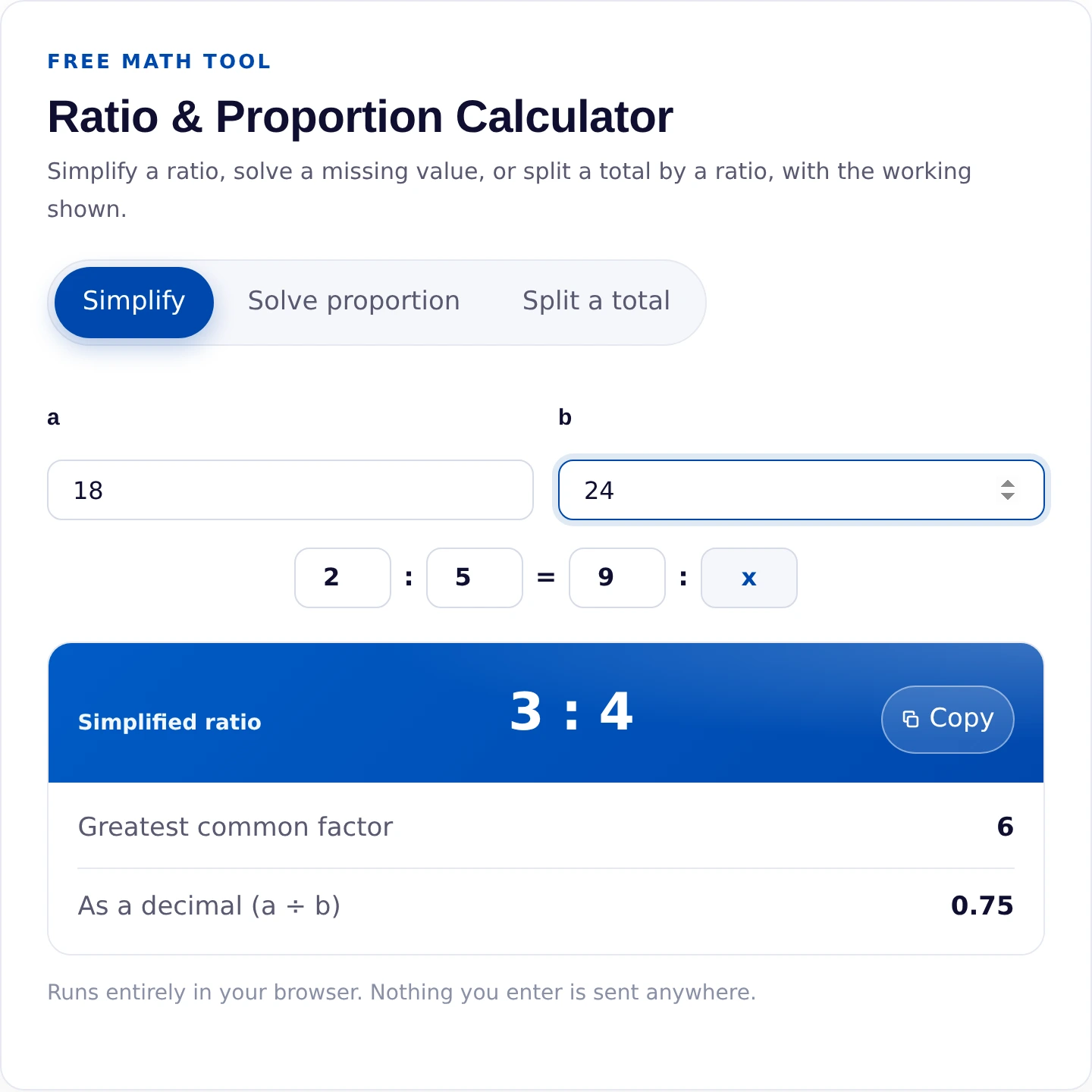
Simplify, solve, or split, in one tool
Our ratio calculator simplifies a ratio, solves for a missing value in a proportion, or splits a total by a given ratio, with the working shown for each.
Open the ratio calculatorFactors, GCF, LCM and primes
A factor of a number divides into it evenly, with nothing left over. Every whole number greater than 1 is either prime, meaning its only factors are 1 and itself, or composite, meaning it breaks down into smaller prime factors. Those prime factors are the building blocks behind both GCF and LCM.
GCF and LCM answer opposite kinds of questions. GCF is what you reach for to simplify a fraction or split something into the largest possible equal groups. LCM is what you reach for to add fractions with different denominators or to line up two repeating events, like two buses that leave every 4 and every 6 minutes and next arrive together after 12 minutes, the LCM of 4 and 6.
Testing whether a number is prime only requires checking divisibility up to its square root, not all the way up to the number itself. To check 97, you only need to rule out division by 2, 3, 5 and 7, since the next prime, 11, is already bigger than the square root of 97. It fails all four, so 97 is prime. 91 looks similar but fails at 7: 91 ÷ 7 is exactly 13, so 91 is composite.
Primes from 1 to 100
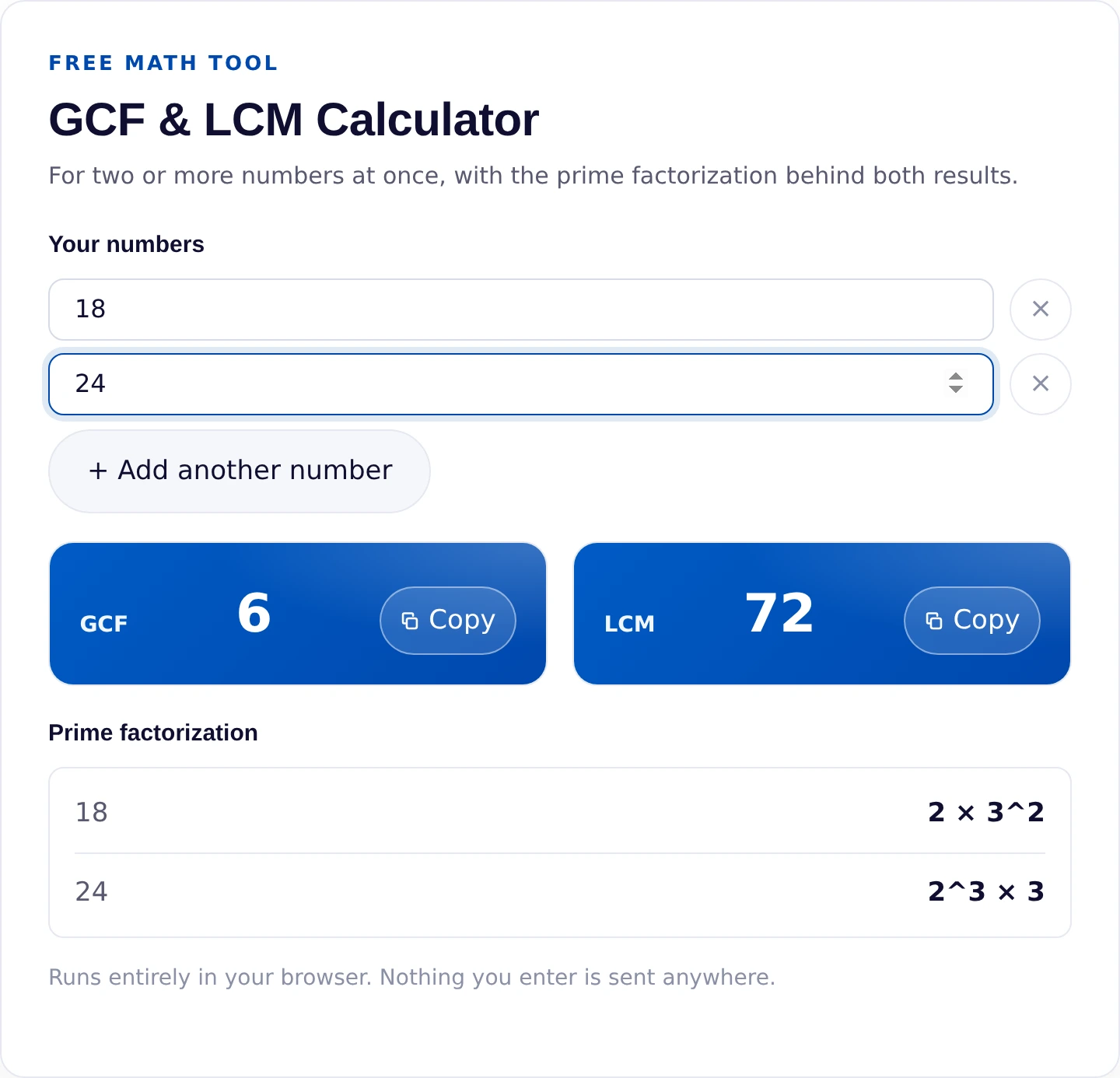
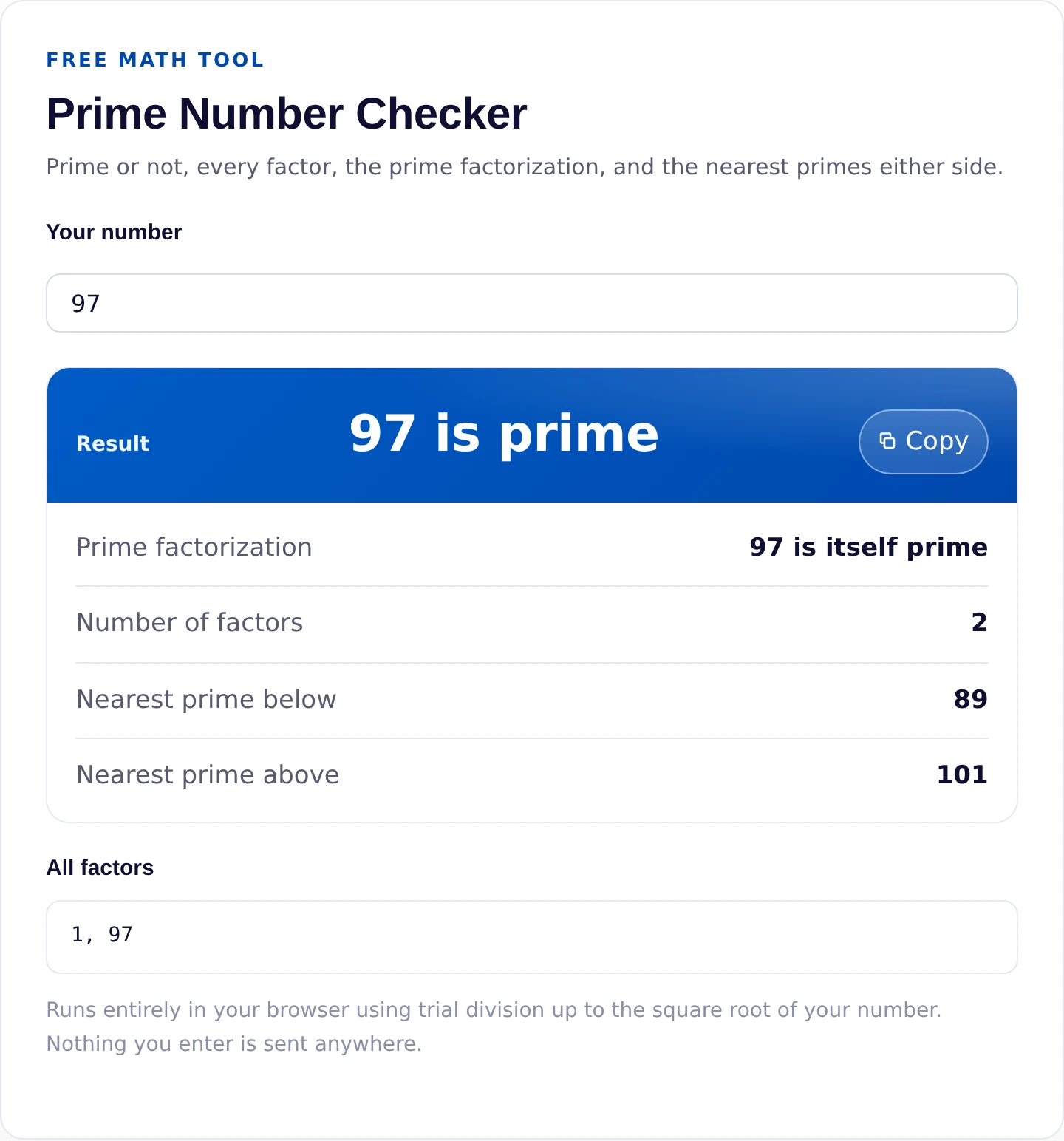
Two tools, one job each
The GCF and LCM calculator shows the prime factorisation of each number and builds both results from it. The prime checker instantly tells you if a number is prime, its full factor list, and the nearest primes either side.
GCF & LCM calculator Prime number checkerExponents and roots
An exponent is repeated multiplication written compactly. 2³ means 2 × 2 × 2, not 2 × 3, which is the single most common exponent mistake there is. Once that distinction is solid, the rest of the rules are mostly about combining exponents when the base stays the same.
Roots are exponents written the other way round. A square root asks “what number, squared, gives me this”, and a cube root asks the same question one power up. √144 is 12, because 12² is 144. The cube root of 8 is 2, because 2³ is 8. Fractional exponents let you write any root using the same notation as a normal power, which is why calculators use x^(1/n) internally instead of a separate root button for every possible root.
The mistake worth avoiding
A negative exponent does not make the result negative. It means “take the reciprocal”. 2−3 is 1/8, a small positive number, not −8. Keep those two ideas in separate mental boxes and this stops being confusing.
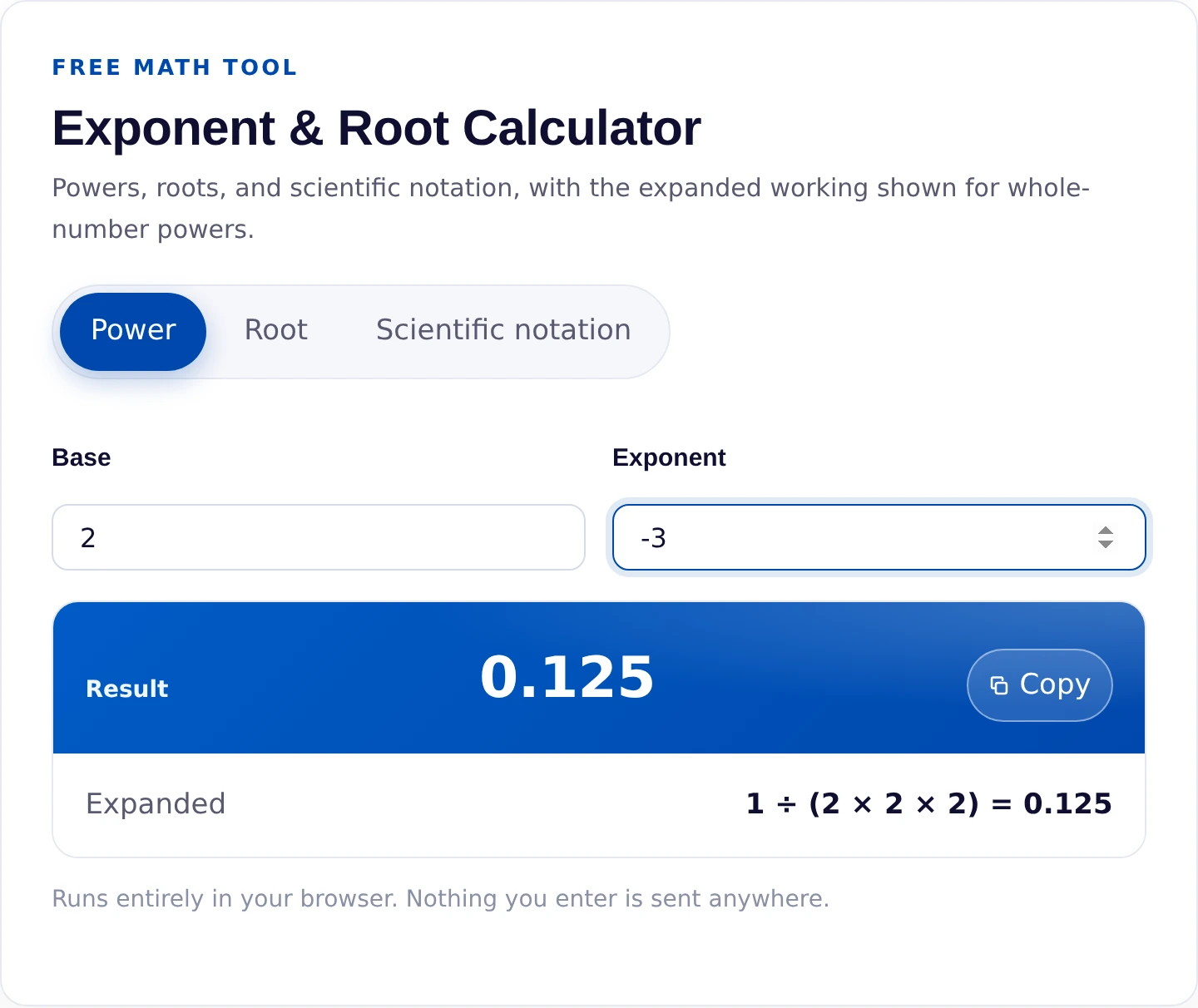
Any power, any root, shown step by step
Our exponent and root calculator raises any number to any power, finds any root, and converts to and from scientific notation, with the expanded working shown for whole-number powers.
Open the exponent calculatorSolving linear equations
A linear equation is one where the unknown appears only to the first power, no x² or x³ anywhere. Solving one is a matter of undoing operations in reverse order until x is alone on one side.
The rule underneath every step is the same one: whatever you do to one side of the equation, you do to the other, so the equality never breaks. When the unknown shows up on both sides, the process is identical, you just gather the x terms onto one side first.
A messier example: 2(x − 3) = 4x + 2
- Expand the bracket: 2x − 6 = 4x + 2
- Move the x terms to one side: 2x − 4x − 6 = 2 → −2x − 6 = 2
- Add 6 to both sides: −2x = 8
- Divide by −2: x = −4
Two special cases are worth recognising by sight rather than solving blind. If every x cancels out and you are left with something false, like 5 = 8, the equation has no solution: no value of x makes it true. If every x cancels out and you are left with something true, like 6 = 6, the equation is true for every value of x, meaning infinite solutions.
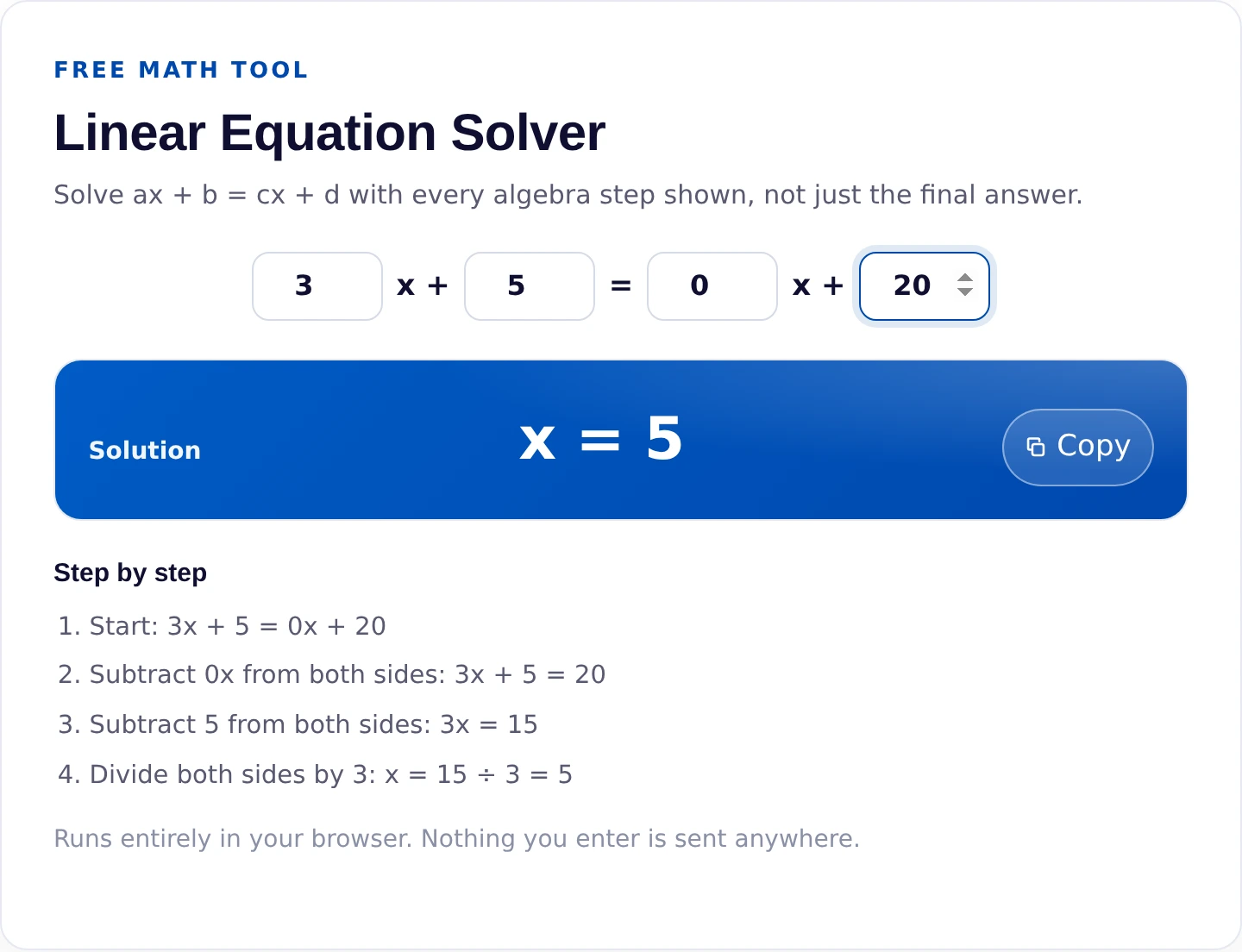
Every algebra step, not just the final value
Our linear equation solver handles ax + b = cx + d, showing each step, and correctly flags the no-solution and infinite-solutions cases instead of guessing.
Open the equation solverSolving quadratic equations
A quadratic equation has an x² term, which means it generally has two solutions instead of one, since two different x-values can produce the same squared result. Among all the math formulas on this page, the quadratic formula has the longest paper trail, with roots in Babylonian problem-solving nearly 4,000 years old. It solves any equation in the form ax² + bx + c = 0, no matter how ugly the numbers are.
Try it on x² − 5x + 6 = 0, where a=1, b=−5, c=6. The discriminant is (−5)² − 4(1)(6), which is 25 − 24, giving 1. Since 1 is positive, expect two real answers: x = (5 ± 1) / 2, which works out to x = 3 or x = 2. You can check this by factoring instead: x² − 5x + 6 factors neatly into (x−2)(x−3), confirming the same two roots without the formula at all.
Not every quadratic factors that cleanly, which is exactly why the formula exists as a fallback that always works. And when the discriminant is negative, like in x² + 4x + 5 = 0, the equation still has solutions, they are just complex numbers rather than points where the graph crosses the x-axis. That graph, a parabola, has its lowest or highest point (the vertex) at x = −b / 2a, directly between the two roots when real roots exist.
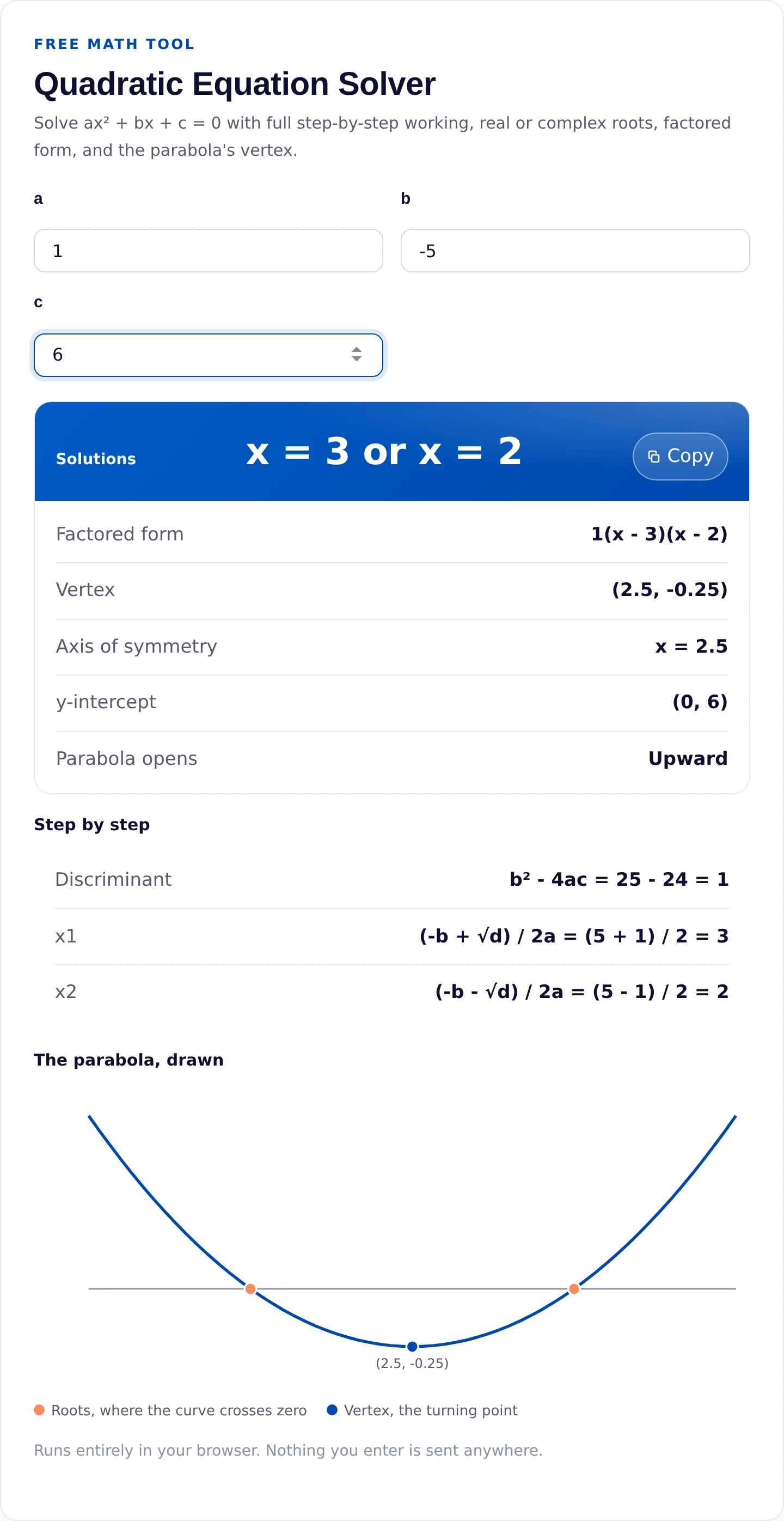
Real, complex, or repeated, handled correctly
Our quadratic solver shows full step-by-step working, gives real or complex roots as needed, the factored form when it exists, and the parabola's vertex and axis of symmetry.
Open the quadratic solverGeometry: area and perimeter
Area measures the space a shape covers, in square units. Perimeter measures the distance around its edge, in linear units. Mixing the two up is the single most common geometry error, and the units are your check: area is always squared (m², ft²), perimeter never is.
The triangle, trapezoid and parallelogram formulas are not separate rules so much as variations on the same idea: a parallelogram is two triangles pushed together into a rectangle-like shape, which is why its area is just base times height with no need to halve it, while a triangle is half of that same rectangle, hence the 1/2. A trapezoid averages its two parallel sides before multiplying by height, which is the same as treating it as the midpoint between a very short and a very long parallelogram.
The Pythagorean theorem
For any right triangle, the square of the longest side (the hypotenuse) equals the sum of the squares of the other two sides.
Those triples are worth recognising on sight, since they turn up constantly in textbook problems specifically because they resolve to whole numbers instead of messy decimals. If a right triangle has legs of 6 and 8, you may notice it is just the 3-4-5 triple doubled, and the hypotenuse is 10 without needing to run the formula at all.
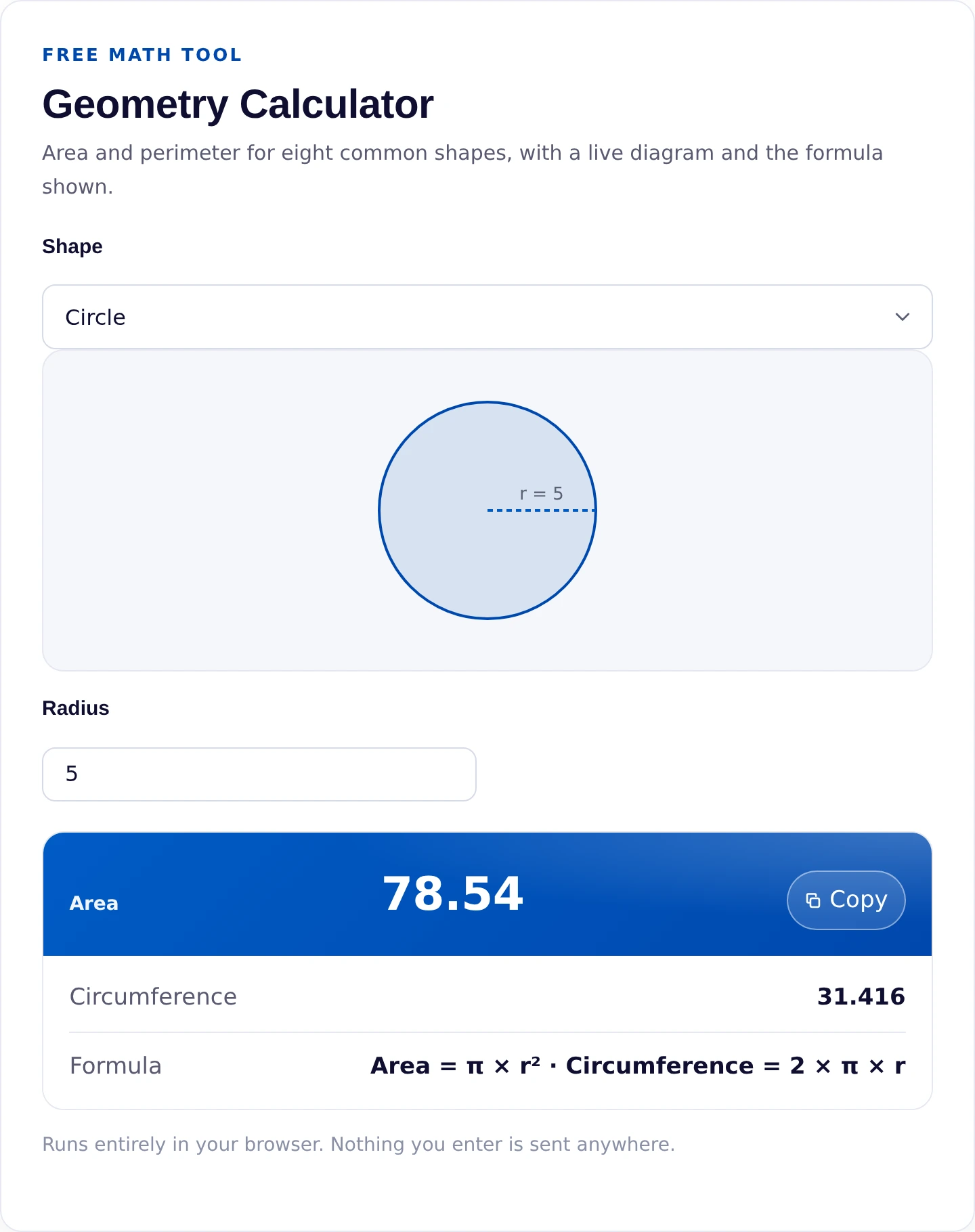
Any shape, with a live diagram
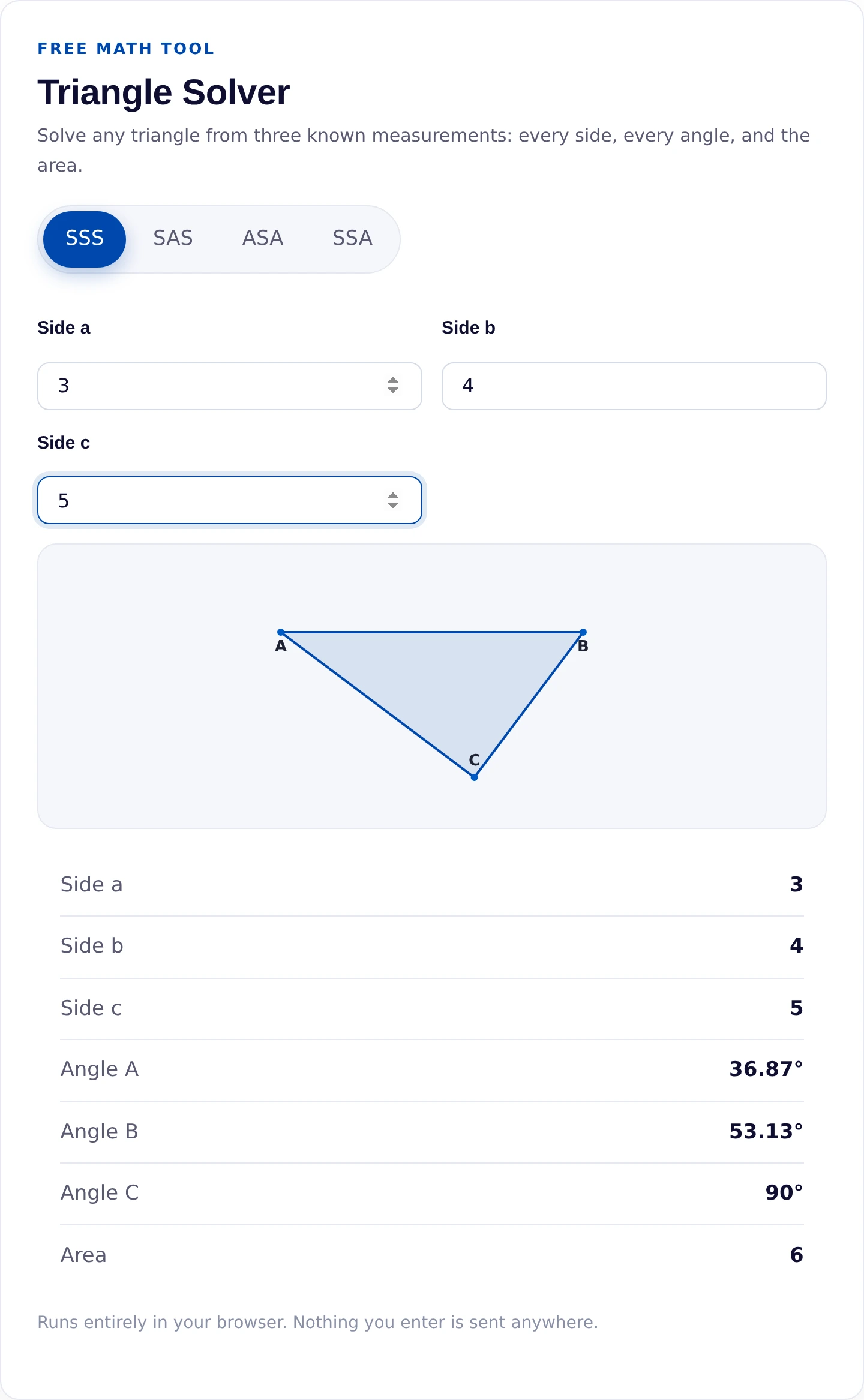
The geometry calculator covers area and perimeter for circles, squares, rectangles, triangles, trapezoids, parallelograms, ellipses and regular polygons. The triangle solver goes further, solving a full triangle from any three known sides or angles.
Geometry calculator Triangle solverStatistics: mean, median, mode and standard deviation
Mean, median and mode are three different ways to answer the same question, "what's typical here", and they can give noticeably different answers on the same dataset. Knowing which one to trust matters as much as knowing how to calculate them.
The mean gets dragged around by extreme values in a way the median does not. Swap that 10 for a 100 and the mean jumps to nearly 15, while the median barely moves, because it only cares about position, not size. That is why household income is almost always reported as a median: a handful of very high earners would drag the mean up to a number that describes almost nobody's actual paycheck.
Standard deviation: population vs. sample
Standard deviation measures how spread out the data is around the mean. A small standard deviation means most values sit close to the mean; a large one means they are scattered. The formula has two versions, and picking the wrong one is a genuinely common error in real analysis, not just in homework.
Dividing by N−1 instead of N for a sample is not an arbitrary convention, and it is one of the more commonly misapplied math formulas in applied statistics. The NIST/SEMATECH Engineering Statistics Handbook is the standard public reference for why the distinction matters. A sample's own mean is, on average, slightly closer to its own data points than the true population mean would be, which makes the raw sample variance a bit too small. Dividing by the smaller number N−1 corrects for that bias. If you measured every member of a group, use N. If you measured a subset and are estimating the whole, use N−1.
Mean, median, mode and both standard deviations at once
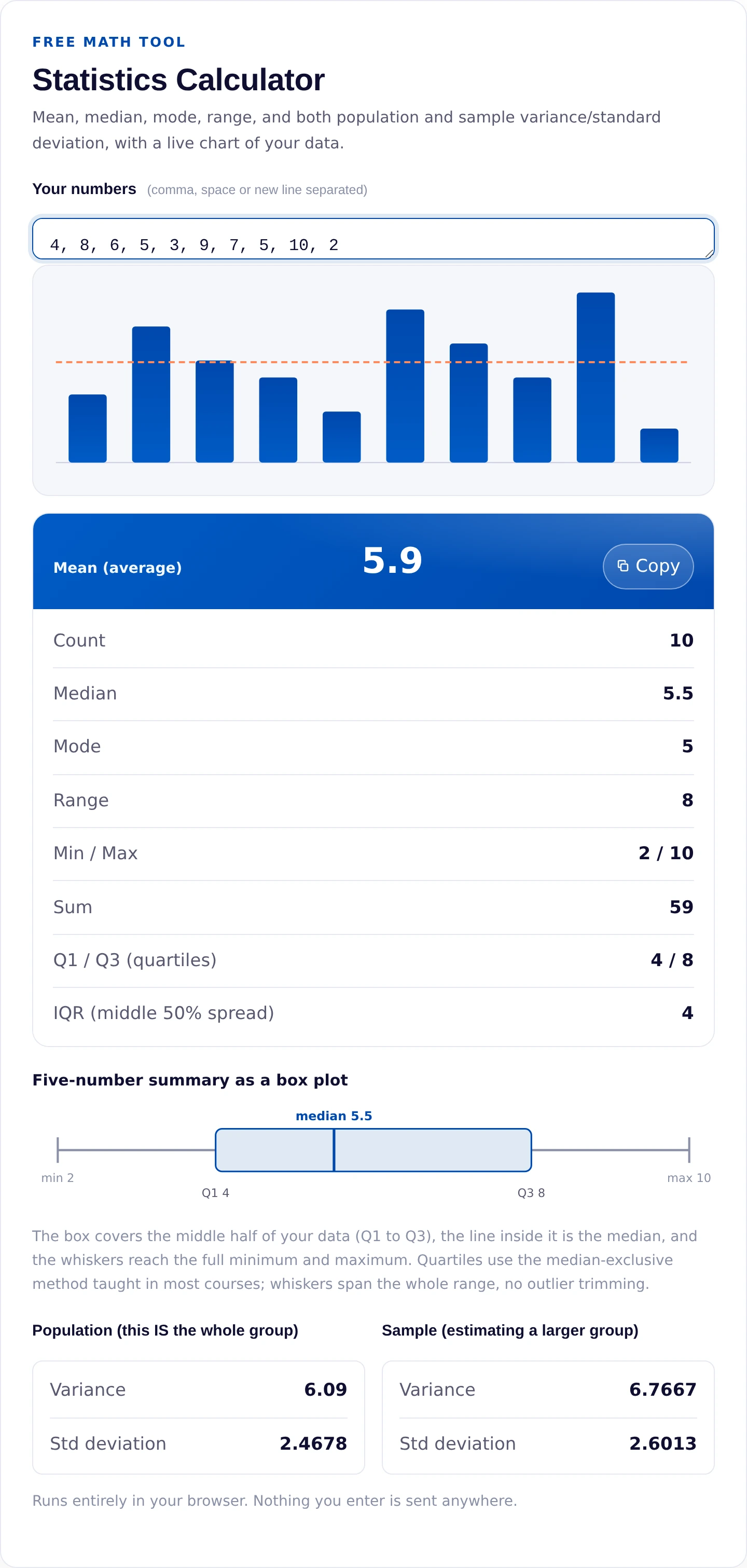
Paste in a dataset and our statistics calculator returns mean, median, mode, range, and both population and sample variance and standard deviation, with a live bar chart of your data.
Open the statistics calculatorBinary, octal, hexadecimal and decimal
Decimal is base 10 because it has ten digits, 0 through 9, before a column rolls over. Every other number base works on the identical idea with a different digit count: binary (base 2) uses only 0 and 1, octal (base 8) uses 0 through 7, and hexadecimal (base 16) needs six extra symbols beyond 9, so it borrows A through F to represent 10 through 15.
Binary matters because it is what a computer's hardware actually stores, every value at the lowest level, as a pattern of on and off. Hexadecimal exists as a convenience layer on top of it: each hex digit represents exactly 4 binary digits, so a byte (8 bits) always fits in exactly 2 hex digits. That clean relationship is why colours on the web are written in hex (#2563EB, six digits, three colour channels of exactly two digits each) and why memory addresses and error codes are shown in hex rather than raw binary.
| Decimal | Binary | Octal | Hex |
|---|---|---|---|
| 1 | 1 | 1 | 1 |
| 2 | 10 | 2 | 2 |
| 4 | 100 | 4 | 4 |
| 8 | 1000 | 10 | 8 |
| 10 | 1010 | 12 | A |
| 15 | 1111 | 17 | F |
| 16 | 10000 | 20 | 10 |
| 31 | 11111 | 37 | 1F |
| 32 | 100000 | 40 | 20 |
| 63 | 111111 | 77 | 3F |
| 64 | 1000000 | 100 | 40 |
| 100 | 1100100 | 144 | 64 |
| 156 | 10011100 | 234 | 9C |
| 255 | 11111111 | 377 | FF |
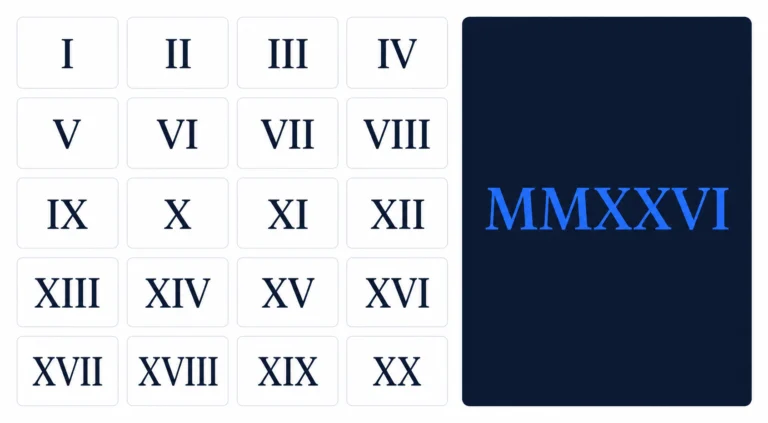
Roman numerals are a number system worth knowing too, though built on a completely different principle (fixed-value symbols rather than place value). If dates, clock faces or the six subtractive pairs are what you are after, the full Roman numerals guide covers that in depth rather than repeating it here.
Every base at once, from 2 to 36
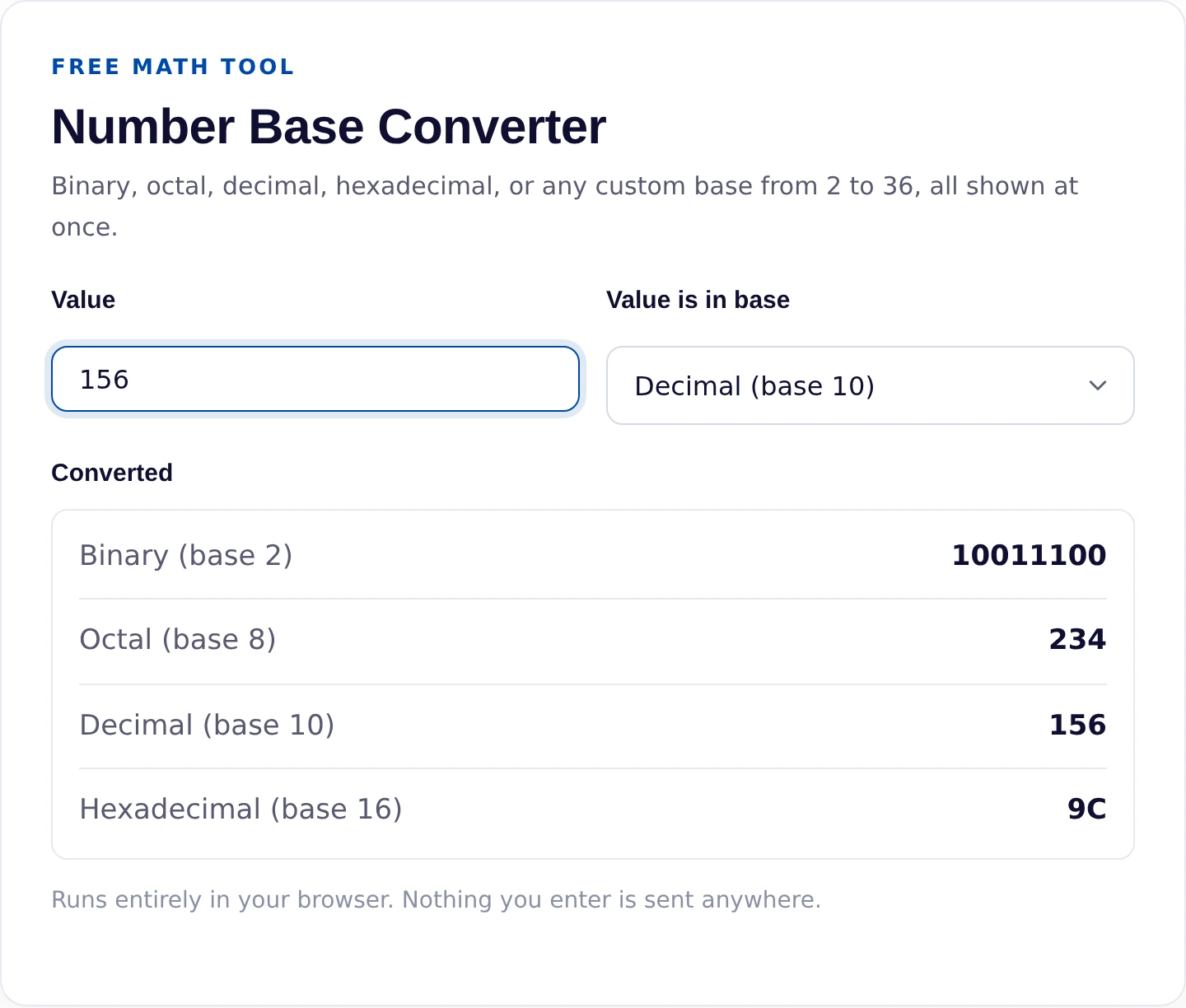
Our number base converter shows binary, octal, decimal and hexadecimal simultaneously, plus any custom base from 2 to 36, with strict per-base digit validation so a typo gets caught instead of silently miscalculated.
Open the number base converterMultiplication tables
There is no shortcut around knowing the multiplication table cold; every calculation above builds on top of it. A few patterns make the memorising considerably faster than brute repetition.
Patterns worth knowing instead of memorising
- ×9: the digits of the answer always add up to 9 (9×4=36, 3+6=9), and the tens digit is always one less than the number you multiplied by
- ×5: half the number, then multiply by 10 (5×8 → half of 8 is 4 → 40)
- ×11 (single digit): just repeat the digit (11×7=77)
- Squares (n×n): worth memorising as a block, since they show up constantly in geometry and the Pythagorean theorem
The facts that trip people up longest almost always live in the same corner of the table: 7×8, 6×7, 7×9, 8×9. None of the shortcuts above cover them cleanly, which is exactly why they are worth drilling on purpose rather than assuming repetition alone will fix it.
The full 12×12 table
| × | 1 | 2 | 3 | 4 | 5 | 6 | 7 | 8 | 9 | 10 | 11 | 12 |
|---|---|---|---|---|---|---|---|---|---|---|---|---|
| 1 | 1 | 2 | 3 | 4 | 5 | 6 | 7 | 8 | 9 | 10 | 11 | 12 |
| 2 | 2 | 4 | 6 | 8 | 10 | 12 | 14 | 16 | 18 | 20 | 22 | 24 |
| 3 | 3 | 6 | 9 | 12 | 15 | 18 | 21 | 24 | 27 | 30 | 33 | 36 |
| 4 | 4 | 8 | 12 | 16 | 20 | 24 | 28 | 32 | 36 | 40 | 44 | 48 |
| 5 | 5 | 10 | 15 | 20 | 25 | 30 | 35 | 40 | 45 | 50 | 55 | 60 |
| 6 | 6 | 12 | 18 | 24 | 30 | 36 | 42 | 48 | 54 | 60 | 66 | 72 |
| 7 | 7 | 14 | 21 | 28 | 35 | 42 | 49 | 56 | 63 | 70 | 77 | 84 |
| 8 | 8 | 16 | 24 | 32 | 40 | 48 | 56 | 64 | 72 | 80 | 88 | 96 |
| 9 | 9 | 18 | 27 | 36 | 45 | 54 | 63 | 72 | 81 | 90 | 99 | 108 |
| 10 | 10 | 20 | 30 | 40 | 50 | 60 | 70 | 80 | 90 | 100 | 110 | 120 |
| 11 | 11 | 22 | 33 | 44 | 55 | 66 | 77 | 88 | 99 | 110 | 121 | 132 |
| 12 | 12 | 24 | 36 | 48 | 60 | 72 | 84 | 96 | 108 | 120 | 132 | 144 |
An interactive table up to 20×20
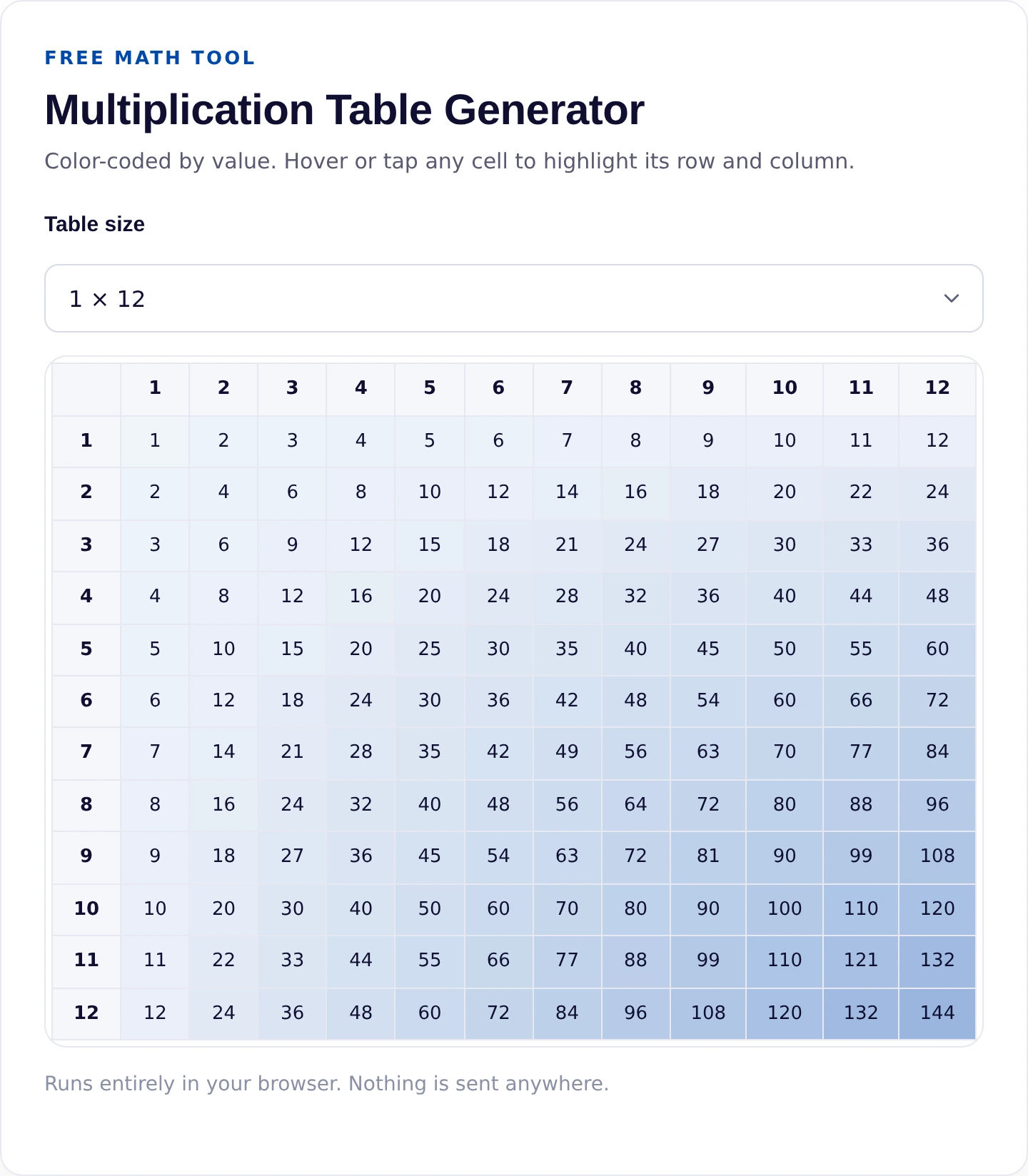
Our multiplication table generator is colour-coded by value, and hovering or tapping any cell highlights its full row and column, which makes patterns like the ones above much easier to actually see.
Open the multiplication tableUnit conversion
Converting between units is really just multiplying by a fraction that equals 1, where the numerator and denominator happen to be the same physical quantity in two different units. Because that fraction genuinely equals 1, multiplying by it changes how the number looks without changing what it means. The official factors NIST publishes are the source behind the unit-conversion math formulas below, accurate to seven significant figures.
Temperature is the one genuine exception to the "multiply by 1" idea above, because Celsius and Fahrenheit do not share a zero point the way metres and centimetres do. Zero degrees Celsius is not zero anything in Fahrenheit, it is 32, so the conversion needs both a multiplication and a shift, not just a multiplication. That is why the Celsius-to-Fahrenheit formula has a "+32" that length and weight conversions never need.
Multi-step conversions chain the same idea. Converting 5 miles to metres means multiplying by two fractions in a row: miles to kilometres, then kilometres to metres, and the units in between cancel out exactly the way they would in a fraction with matching top and bottom terms.
Length, weight, temperature, volume, and more
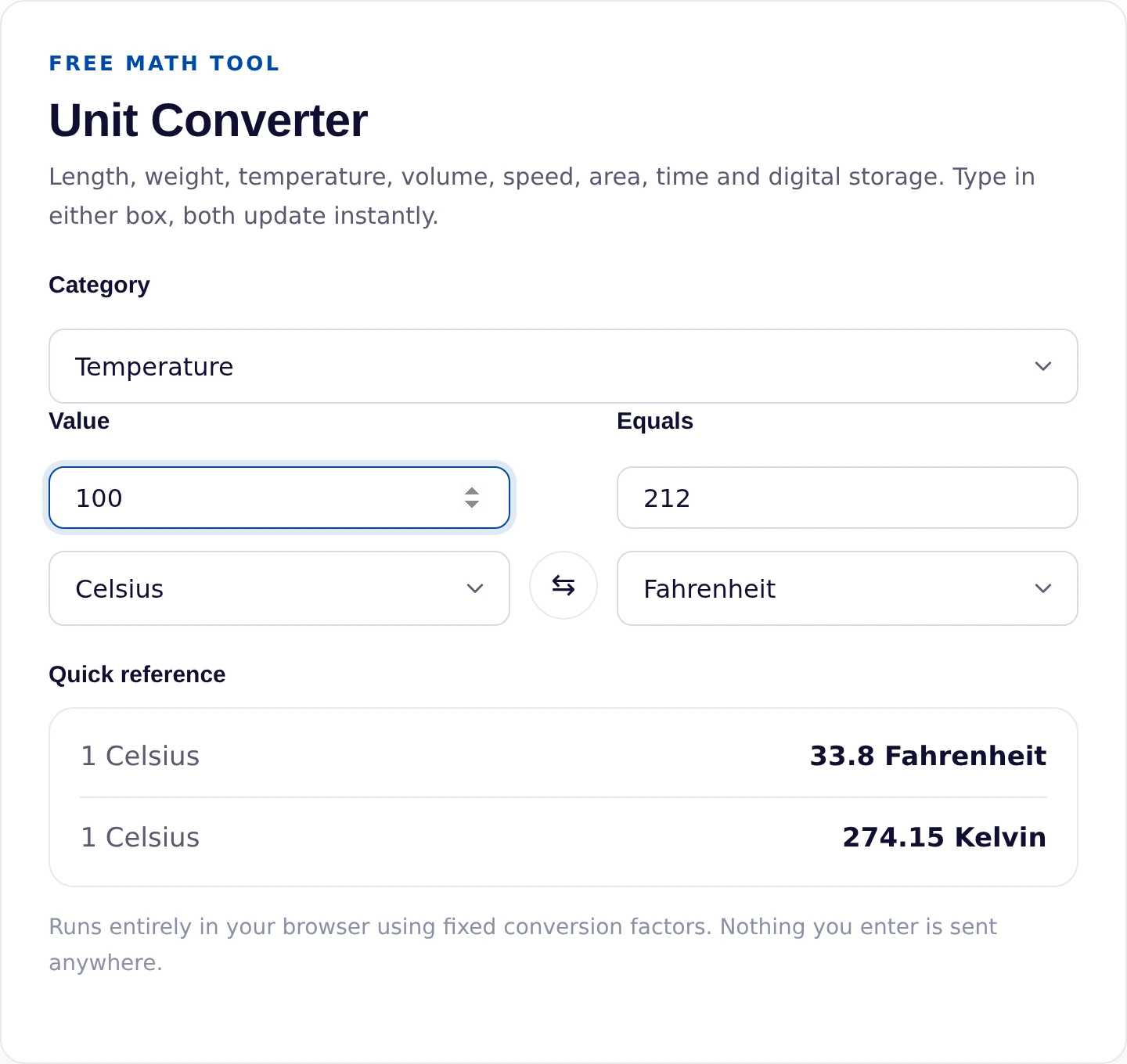
Type into either box and our unit converter updates both instantly, covering length, weight, temperature, volume, speed, area, time and digital storage, with a quick-reference table for the units you picked.
Open the unit converterFrequently asked questions
What is the correct order of operations, PEMDAS or BODMAS?
They are the same rule taught under different names in different countries. PEMDAS (Parentheses, Exponents, Multiplication/Division, Addition/Subtraction) is standard in the US; BODMAS (Brackets, Orders, Division/Multiplication, Addition/Subtraction) is standard in the UK and much of the Commonwealth. Multiplication and division are always equal priority to each other, as are addition and subtraction, regardless of which acronym you learned.
Why do you flip the second fraction when dividing?
Dividing by a number and multiplying by its reciprocal are the same operation, since a number times its reciprocal always equals 1. Dividing by 3/4 gives the identical result as multiplying by 4/3, which is why "keep, change, flip" works as a shortcut for fraction division.
What is the difference between population and sample standard deviation?
Population standard deviation divides by N and is used when your data covers an entire group. Sample standard deviation divides by N−1 and is used when your data is a subset being used to estimate a larger population; the smaller divisor corrects for a sample's tendency to slightly underestimate the true spread.
How do you know if a quadratic equation has real or complex solutions?
Check the discriminant, b² − 4ac. If it's positive, there are two real solutions. If it's exactly zero, there is one repeated real solution. If it's negative, both solutions are complex numbers, since you would be taking the square root of a negative number.
Why can't hexadecimal use ten digits like decimal?
Hexadecimal is base 16, so it needs 16 distinct symbols before a column rolls over, one more than the ten digits decimal has available. It borrows the letters A through F to represent the values 10 through 15, keeping every digit a single character.
What's the difference between a percentage point and a percent?
A percentage point is an absolute difference between two percentages, found by simple subtraction. A percent change is a relative difference, found by dividing that same gap by the original value. A rate moving from 5% to 7% is a 2 percentage point increase, but a 40% relative increase, since the 2-point gap is 40% of the original 5.
Do I use GCF or LCM to add fractions with different denominators?
LCM. You need the smallest number both denominators divide into evenly, which becomes your common denominator. GCF is what you use afterward, if at all, to simplify the final answer.
Do I need to memorise these math formulas, or is it fine to just look them up?
Look them up as often as you need to. Memorising was never really the point. Understanding why each formula works is what lets you catch a wrong answer and adapt a formula to a slightly different problem, which a memorised string of symbols cannot do on its own. Treat this page as reference material, the way you would a dictionary.
The bottom line
Every topic on this page connects to at least one other. Fractions feed into ratios and percentages. GCF and LCM feed into fraction addition and simplification. Exponents feed into the quadratic formula. The Pythagorean theorem feeds into the triangle solver. None of it is really 14 separate subjects, it is one connected set of tools that keeps getting reused.
The math formulas here are correct as written and checked against actual computation, not retyped from memory. Copy them, adapt them, and when the arithmetic gets long enough that doing it by hand stops being useful, every section links straight to the calculator built for exactly that job.
Quick reference: every math formula
Every math formula on this page, condensed to one card. Bookmark this section if you only came back for one.
Order of operations
Parentheses, Exponents, Multiplication/Division (left to right), Addition/Subtraction (left to right).
Negative numbers
Same signs multiply/divide to positive. Different signs multiply/divide to negative. Subtracting a negative is the same as adding.
Fractions
Add/subtract: match denominators first. Multiply: straight across. Divide: flip the second, then multiply.
Percentages
X% of Y = (X/100) × Y. Percent change = ((new−old)/old) × 100, always divided by the old value.
Ratios & proportions
Simplify by dividing by the GCF. Solve a/b = c/d by cross-multiplying: a×d = b×c.
GCF & LCM
GCF: shared prime factors at the lowest power. LCM: every prime factor at the highest power. LCM(a,b) = (a×b)/GCF(a,b).
Exponents & roots
x^a × x^b = x^(a+b). x^a ÷ x^b = x^(a−b). (x^a)^b = x^(ab). x^0=1. x^−a = 1/x^a. x^(1/n) = n-th root.
Linear equations
Isolate x by undoing operations in reverse, applying every step to both sides equally.
Quadratic formula
x = (−b ± √(b²−4ac)) / 2a. Discriminant sign tells you real, repeated, or complex roots.
Geometry
Square A=s². Rectangle A=lw. Triangle A=½bh. Circle A=πr². Pythagorean: a²+b²=c².
Statistics
Mean = sum/count. Median = middle value. Mode = most frequent. Std dev: divide by N for a population, N−1 for a sample.
Number systems
Binary=base 2, octal=base 8, hex=base 16 (using A–F for 10–15). Convert by repeated division, reading remainders bottom-up.
Unit conversion
Multiply by a fraction that equals 1. Temperature is the exception: it needs a shift, not just a multiplier.
Last reviewed August 2026. See how we review and our affiliate disclosure.